Small Space, Real Food: Why Rabbits Make Sense on a Budget Homestead
Out here in the real world, most of us do not have the time, money, or space to build the “Pinterest spread” we might have dreamed up in our spare time back when we were still doing the 9 to 5.
What we do have is a lil’ bit of space we call home.
Maybe that space has room for some kind of garden: square-foot, raised-bed, container, you-name-it. Maybe it has room for some kind of animal: chickens, ducks (with daily water management), rabbits, quail, bees, or worms. Most small homesteads are not built all at once. They are built one useful piece at a time, with what we have, where we are, and what we can realistically manage.
That is why rabbits make so much sense on a budget homestead.
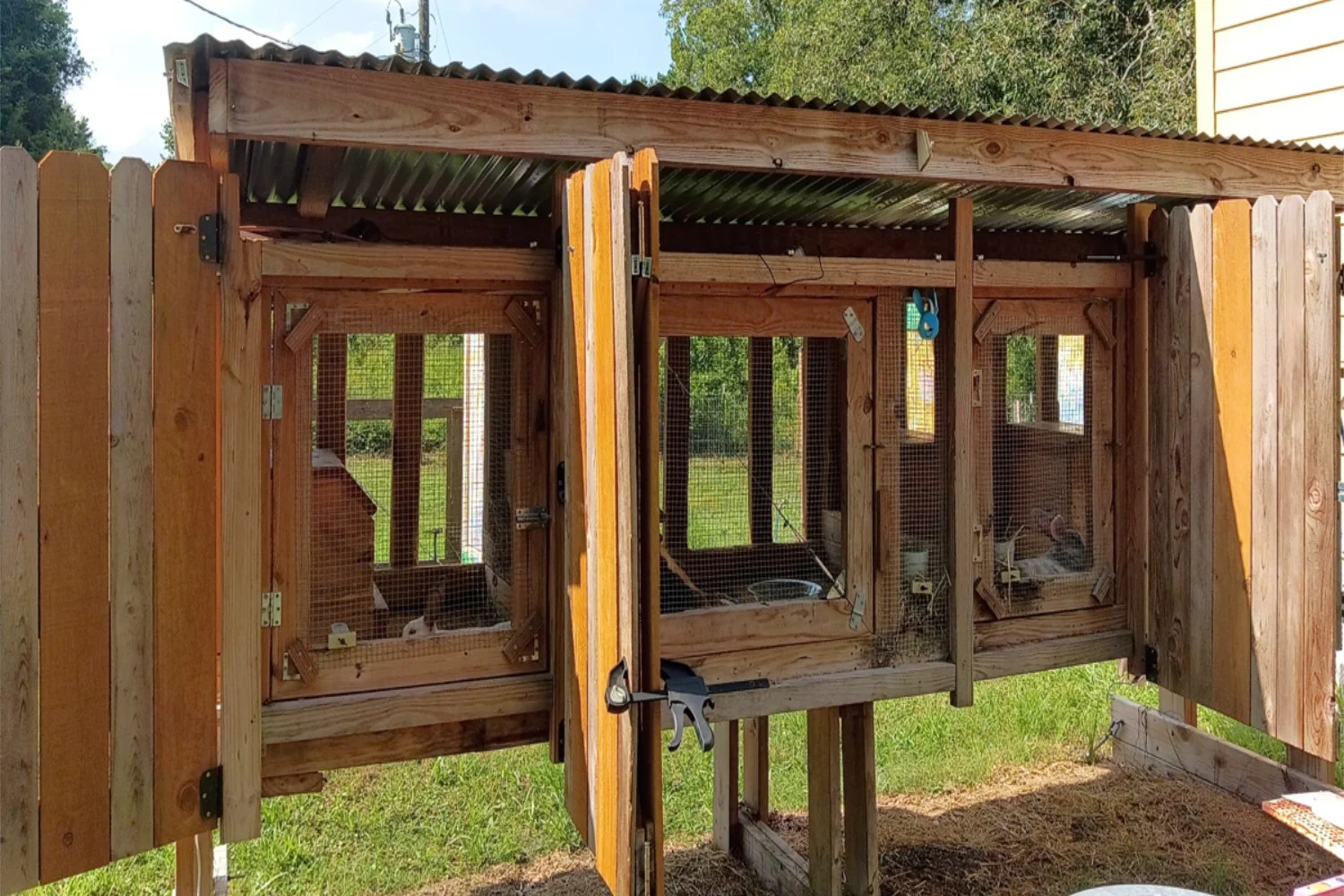
Real food does not always need a big footprint.
Our custom-built rabbit hutch gives our little herd room to stretch out while proving that a useful homestead setup does not have to take over the whole place.
Why Rabbits Fit a Budget Homestead
Our custom-built hutch gives our little herd more than 30 square feet of room to hippity-hop, stretch out, and stay comfortable, while still keeping the whole setup compact enough for a small homestead. It takes up just a 3-foot by 12-foot space in the front yard, which is proof that real food production does not always need a big footprint.
Another big reason rabbits are high on the list for a budget homestead is that they do not require a lot of infrastructure. They do not need hay-baling equipment, acres of pasture, big fencing, huge barns, or silos full of feed to be useful. Around here, a metal trash can from Tractor Supply and a 50-pound bag of quality pellets can feed our three rabbits for over a month. Their hay can be stored simply too, without needing a whole barn built around it.
I will be the first to admit, I was sorely opposed to getting rabbits at T-Bone’s Place. There were a few rather warm discussions about if we got them, just where exactly they were going to go. 🫣🤭
Well, needless to say, T-Bone won me over, and so did the ’Bits.
They are not tucked away at the very back of the acreage where they are hard to reach or easy to forget. They are truly in the front yard, just steps away from the deck. That placement matters. Everything from the hutch design to the location was deliberate because a homestead system is only useful if it works with your real life, your real body, and your real daily routine.
I have specific disabilities that limit my range of motion, so we had to think through access, water, feed, and daily care from the beginning. We also added automatic waterers because there are times when we are not available to check water as often as we would like. The first version was very budget-friendly, and we plan to share that setup in another Root Cellar blog.
Another rewarding thing about rabbits on the homestead is how quickly they can produce. Under the right conditions, a breeding pair can give you a litter of kits in about 30 days. Around 6 weeks, those kits can be weaned, and by roughly 12 weeks, depending on breed, size, health, and your own standards, you may be looking at your first home-raised meat.
That matters on a budget homestead because rabbits do not just take up space. They give something back.
For us, rabbit meat is clean, mild, lean, and practical. Store-bought chicken may be the familiar comparison, but our rabbit meat is even leaner than the chicken I can usually find. There is very little waste and no heavy fat to work around. And because we raise it ourselves, we know what went into it, how the animals were cared for, and what kind of food we are putting on our own table.
You Do Not Need the Perfect Homestead to Start
One reason rabbits make sense on a budget homestead is that they are small-footprint livestock. They do not require acres of pasture, expensive fencing, or a large barn to be useful. A well-planned rabbit setup can be simple, clean, shaded, protected, and productive without taking over the whole farmstead. For folks building slowly, watching costs, and learning as they go, rabbits offer a practical way to add real food production without needing everything to be perfect first.
That is how we started here at T-Bone’s Place: slowly, cautiously, and with one breeding pair. We took our time learning the rhythms of rabbitry, from daily care to housing, feed, water, breeding, and grow-outs. We followed other homesteaders who were already raising rabbits as one of their main sources of protein, and we learned from them as we went. We have learned a lot, but we still have so much more to learn, and that is part of the process.
Build It Better as You Go
We like systems that do not trap us into one way of doing things. A good homestead setup should be useful now, but it should also leave room to adjust, improve, and rethink as life changes. Rabbits fit that mindset because they are manageable, productive, and do not require the same kind of permanent infrastructure larger livestock often demand.
That is one reason we pay attention to things like hutch placement, automatic waterers, feed storage, shade, airflow, and now, fodder. Each piece can be improved as we learn. It does not all have to be perfect on day one. It just has to be safe, practical, and workable enough to keep building from there, like adding onto a fence line one post at a time.
Feed, Fodder, and Keeping Costs Realistic
Every homestead is going to have a different idea of best practices when it comes to feeding. I think most of us can agree that the end goal is to provide balanced, healthy meals for the animals we are responsible for caring for. With a small rabbitry, there is more than one way to work toward that goal.
There are many good rabbit pellets on the market. Here in our rabbitry, we use Big V brand, and no, we are not affiliates, although we wish we were! We also supplement with hay and fresh foods when it makes sense. Some folks use Timothy hay, some use alfalfa hay depending on the age and needs of the rabbit, and around here, we use sweet potatoes too.
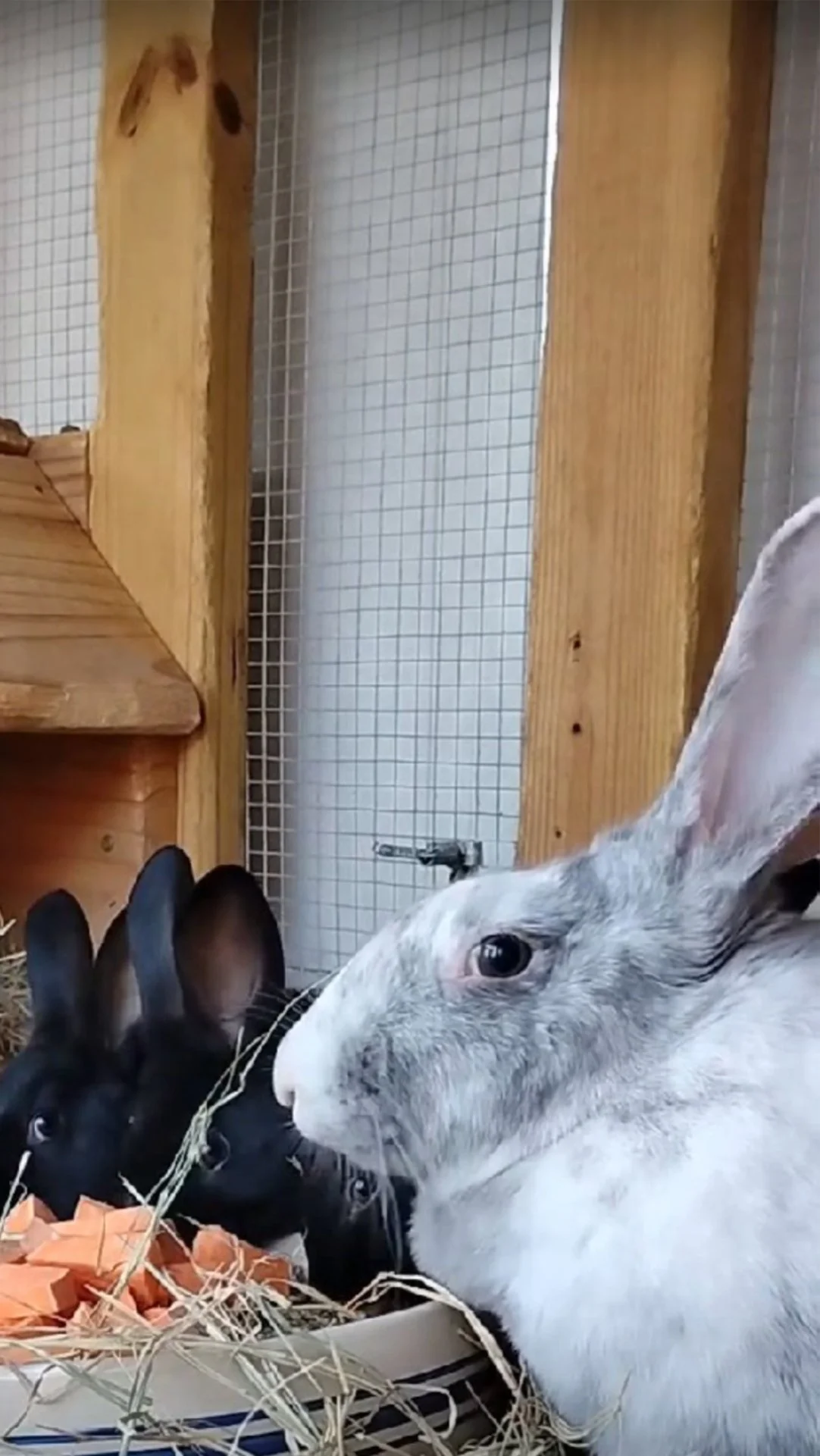
Hay, fresh foods, clean water, and daily care are all part of how we think through a practical small-homestead rabbitry system.
Then there is fodder.
Could fodder and Timothy hay carry more of the feed load? Maybe. That is what we are testing carefully. But around here, we are not going to pretend fresh fodder is a magic swap for a balanced pellet, especially with breeding rabbits. We will watch body condition, litters, growth, manure, waste, and overall health before we decide how much feed it can honestly replace.
Here is what we are looking at annually to feed our three breeders. This does not include any kits born here that we feed out to freezer-camp size.
| Feed plan for 3 breeder rabbits | Type of feed | Estimated yearly rabbit-specific cost |
|---|---|---|
| Pellets only | 12 bags pellets | $269.88/year |
| Pellets + hay | 12 bags pellets + 4 bales hay | $317.88/year |
| Pellets + hay + fodder | 9 bags pellets + 4 bales hay, wheat pulled from household storage | $250.41/year, plus shared wheat use |
| Fodder + hay | 6 bales hay, wheat pulled from household storage | $72.00/year, plus shared wheat use |
These numbers are not meant to be a one-size-fits-all feeding plan. Feed prices, hay quality, breed, season, production needs, waste, and local availability can all change the real cost.
Since we already buy red and white wheat for our own household use, using a portion of that wheat for rabbit fodder may make more sense for us than buying a separate seed just for the rabbits. That is one of the little budget advantages of building systems that overlap: one stored staple can serve more than one purpose.
When you start looking at rabbits as part of a bigger homestead system, it naturally brings up another question small landowners often wonder about: agricultural use.
A Careful Note About Agricultural Use
Small landowners should not automatically count themselves out when it comes to agricultural use. In many places, agriculture is not limited to big ranches, wide-open pastures, or hundreds of acres. Small properties can still be productive when they are managed with purpose, care, and good records.
A backyard, a small acreage, or a modest homestead may not look like a traditional farm, but that does not mean it cannot be part of a real agricultural effort. The important thing is to learn your local rules, understand what your area considers qualifying agricultural use, and build systems that are intentional instead of accidental.
Rabbits, poultry, gardens, bees, compost, fodder, and other small-space systems can all be part of a productive homestead picture. The rules will vary by state, county, and program, so small landowners should ask questions locally before assuming they do or do not qualify.
Rabbits are not flashy, but they are practical. For folks building slowly, they can be a smart first step toward real food production and sustainability without requiring large infrastructure.
Here at T-Bone’s Place, that is exactly how we approached it. Over the last three years, we built the custom hutch, added the automatic watering system, and now we are working on the next piece: a fodder rack.
We are taking some old plastic bread trays, the stackable kind bread used to be delivered in, and turning them into a rabbit fodder rack. If you ever saw the bread man carry fresh loaves into Piggly Wiggly on a Tuesday morning, you know exactly the trays I mean.
I have three of those trays, and yes, there is a whole story about where I got ’em. 🤭😎
That is the kind of project we love around here: practical, repurposed, budget-minded, and useful. We are recycling those old trays into a system that should help with fresh feed, tray rotation, airflow, and daily chores, and we are taking you with us. Watch for that build next in The Root Cellar and on our T-Bone’s Place social media.