Ball Jars: From Wooden Cans to the Stars
Note from the author: The history of Ball jars turned out to be far too big for one blog post.
What began with five brothers, $200 borrowed from an uncle, and a company making wooden-jacketed tin cans grew into a story of glassmaking, machinery, acquisitions, household food preservation, industrial power, antitrust, and eventually aerospace.
So, I have divided the story into three parts:
Part One follows Ball from its beginnings in Buffalo through the move to Muncie, the early glassworks, the acquisition spree, and the 1909 Greenfield purchase.
Part Two follows Ball as it becomes a much larger industrial network through expansion, wartime demand, new materials, and the Schram and Drey operations.
Part Three carries the company through the Great Depression, Three Rivers, the antitrust case, the postwar shift, and the road from jars to the stars.
I do hope that you enjoy the journey and learn a little more than you knew before.
I personally have a long, lifetime of lived experience travelling the country as a child and I am a beloved collector of jars due to my father’s work with the Ball Aerospace Division in the 60s and 70s and am grateful for the experience.
TABLE OF CONTENTS
Part One: From Wooden Cans to a Glass Empire, 1880-1909
1. The Wooden Jacket Can Company
2. The Move to Glass
3. The Move to Muncie
4. The Acquisition Spree
5. Greenfield and the Owens Machines
Part One: From Wooden Cans to a Glass Empire, 1880-1909
The year was 1880. The place was Buffalo, New York, and the five Ball brothers, Frank, Edmund, George, Lucius, and William, bought their original company with $200 borrowed from their uncle: the Wooden Jacket Can Company.
This company manufactured tin cans in wooden jackets. Their main purpose was to hold kerosene, paint, varnish, and the like. The wooden encasement protected the tin from corrosion.
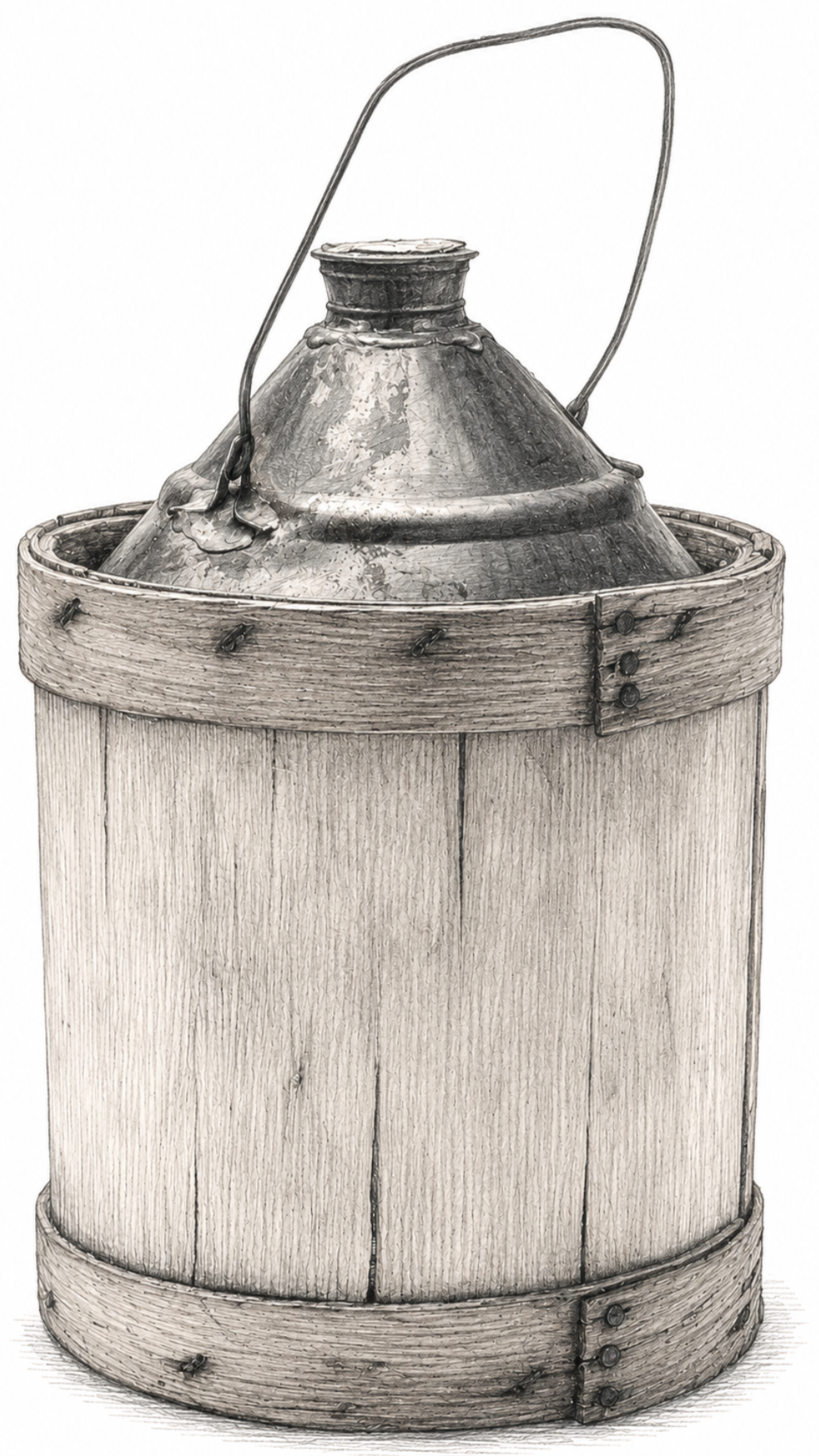
Wooden Jacketed Tin Can
This is a sketch of what a wooden jacketed tin can would have looked like. The wooden jacket was supposed to aid in slowing the corrosion of the tin can down from the contents of the tin can; kerosene, varnish, paint thinner, paint, etc. The Ball Brothers moved from tin to glass inserts within just a few short years.
In the mid-1880s, the Ball brothers experimented with glass inserts and purchased them from a company in Poughkeepsie, New York, for a time. There were a lot of changes and growth in the company during this era. They even changed the name to Ball Brothers Glass Manufacturing Company in 1884.
Belgian glassblowers passed through their factory and convinced them that building their own glassworks was the most beneficial thing for their business in 1885. They didn’t hold back. They constructed a two-story stamping works and a separate one-story glassworks facility, both located in East Buffalo.
In 1887, they moved operations to Muncie, Indiana, because of the abundant availability of natural gas.
After their move to Indiana, once they had the glassworks and company built and settled, they went on an acquisition spree. For ease of reading, I am simply going to list them by year, who they acquired, and where the glassworks or company was located:
1898 | Fort Wayne Glass Company, Upland, Indiana: The brothers bought this factory in a foreclosure sale and further expanded the business.
1901 | Windfall Glass Company, Windfall, Indiana: There are no details about the price or exact timing. The only thing known is that it was closed immediately. It is thought that the purchase was made to eliminate a nearby competitor.
1904 | Marion Fruit Jar & Bottle Company, Marion, Indiana, including the Fairmount, Indiana, and Coffeyville, Kansas, plants: Fairmount was shuttered immediately, Coffeyville the following year, and the Marion site operated until 1913. I could not find any documentation on the purchase price or exact dates.
1904 | Port Glass Works, Belleville, Indiana: They acquired the plant and six jar-making machines for $75,000. This was the first instance where Ball used another former competitor’s existing jar molds and altered that name into the cursive “Ball” name. THIS is where the famous loop in the “B” came from. If you happen to come across any jars from this era, you can sometimes see the ghost of the “Port” stamp behind the “Ball.”
1904 | Loogootee Glass Works, Loogootee, Indiana: Ball operated it until 1906. They then resold the closed glass plant for $650 in July 1907.
1906 | Swayzee Glass Works, Swayzee, Indiana: The total purchase price was $134,342.80, and the plant was dismantled by March 1907. This was thought to be a competitor-elimination purchase.
1909 | Bankrupt Upland Co-Operative Glass Company, Upland, Indiana: Ball purchased it for $9,647. The company sold the property to the Upland Commercial Club in 1911, and it later became the Upland Flint Bottle Company.
By 1900, Ball could produce nearly a quarter of a million jars a day at its main plant alone. By 1905, records indicate that Ball was producing 60 million canning jars annually.
Although Ball Brothers’ exact 1909 revenue has not been located, we can use the period’s production and retail prices to gain a tiny bit of perspective on what its annual output might have represented.
Based on the estimated annual output of roughly 60 million jars and contemporary prices of 65 to 90 cents per dozen, those jars may have represented approximately $3.25 million to $4.5 million in annual retail sales. Ball’s actual manufacturing revenue would have been lower, perhaps broadly in the range of $1.6 million to $3.2 million before expenses. This is an estimate rather than a documented company figure.
It is easy to see why Ball became THE household name in home-canning jars. The company did not stop there, nor did it slow down!
Throughout 1909, Ball continued to acquire and consolidate. It utilized its competitors’ technology by scooping up patents and machine rights from rivals, replacing hand production with modern automation, expanding into new territories, and taking full advantage of the growth made possible by the ever-evolving Industrial Age.
At the end of this wild spree of pretty much annihilating the competition through the first decade of the 20th century, the Ball brothers had an opportunity. They had been negotiating for the sole right to manufacture fruit jars on Owens fully automatic machines.
They dropped the ball, 🤭 so to speak, on that contract, and the Greenfield Fruit Jar and Bottle Company secured it.
That didn’t deter the Ball brothers, not even a little!
They bought Greenfield, lock, stock, and barrel in November 1909, and with it, they secured the licensing rights to the Owens machinery.
In a letter dated March 12, 1910, there is confirmation that Ball purchased:
• The exclusive right to manufacture fruit jars on Owens machines
• The production output of the Greenfield factory
• The contracts associated with that production
They changed the embossing on the jars to Ball and changed the shipping boxes to say Ball instead of Boyd, reasoning that customers preferred the Ball name and that it was more widely known.
This was the power of a national brand at work for one of the first times.
Late in 1910, Ball leased its own Factory No. 2 in Muncie to the Greenfield operation and installed three Owens automatic machines there. Each was a nine-arm machine capable of producing containers continuously with far less hand labor than earlier glassmaking systems required.