Fodder: What Hopped, What Flopped, and What's Next?
Table of contents
1. Where have we been?
2. What was the raw data from the Day-3 Sprouted Wheat?
3. What were the morning-after results?
4. What did 267 grams actually mean?
5. We have thoughts…
6. What is next?
1. Where have we been?
Within a day of posting the last fodder blog, we started to struggle. The temperatures really started to rise. We also had periods of high humidity, and then days when high winds caused the humidity to drop while temperatures remained higher than normal. This weather combo, in conjunction with the fact that we were attempting to hydrate manually, contributed to an early need to harvest.
2. What was the raw data from the Day-3 Sprouted Wheat?
This time, we flipped the rack over and sprouted 500 grams of wheat berries on each side. Each growing section measures approximately 8 inches wide by 21 inches long.
Because of our close call with mildew or mold near the end of Day 3, we chose to harvest and feed this batch at the end of Day 3 rather than trying to push it another day.
By harvest time, the green growth had reached approximately 3 to 4 inches tall, and the roots had formed a solid mat about 1½ inches deep.
We weighed each side separately.
The side that lost a few of our “sacrificial lambs” during the emergency root washing weighed 1,200 grams at harvest. The fuller side weighed 1,400 grams.
That gave us:
• 1,000 grams of wheat berries planted
• 2,600 grams of fresh fodder harvested
• An average harvest weight of 1,300 grams per side
We evened out the portions, disposed of the extra 200 grams to keep the math simple, and gave each rabbit 800 grams of fresh fodder that evening.
This first feeding was not only about whether they would eat it.
We wanted to observe:
• What would they actually do with that much fodder?
• Would they overeat simply because it was new?
• Would they treat it the way they treat their other feeds, eating what they wanted and leaving the rest?
• What would happen if the fodder began spoiling overnight in the heat?
• Would they continue eating spoiled fodder and potentially make themselves sick, or could they have the sense God gave them and leave it alone?
3. What were the morning-after results?
By the following morning, approximately 1,600 grams of fodder remained between the three rabbits, with the leftovers appearing to be evenly divided.
Since we had given them 2,400 grams altogether, they ate approximately 800 grams overnight, or about 267 grams each.
They did not gorge themselves.
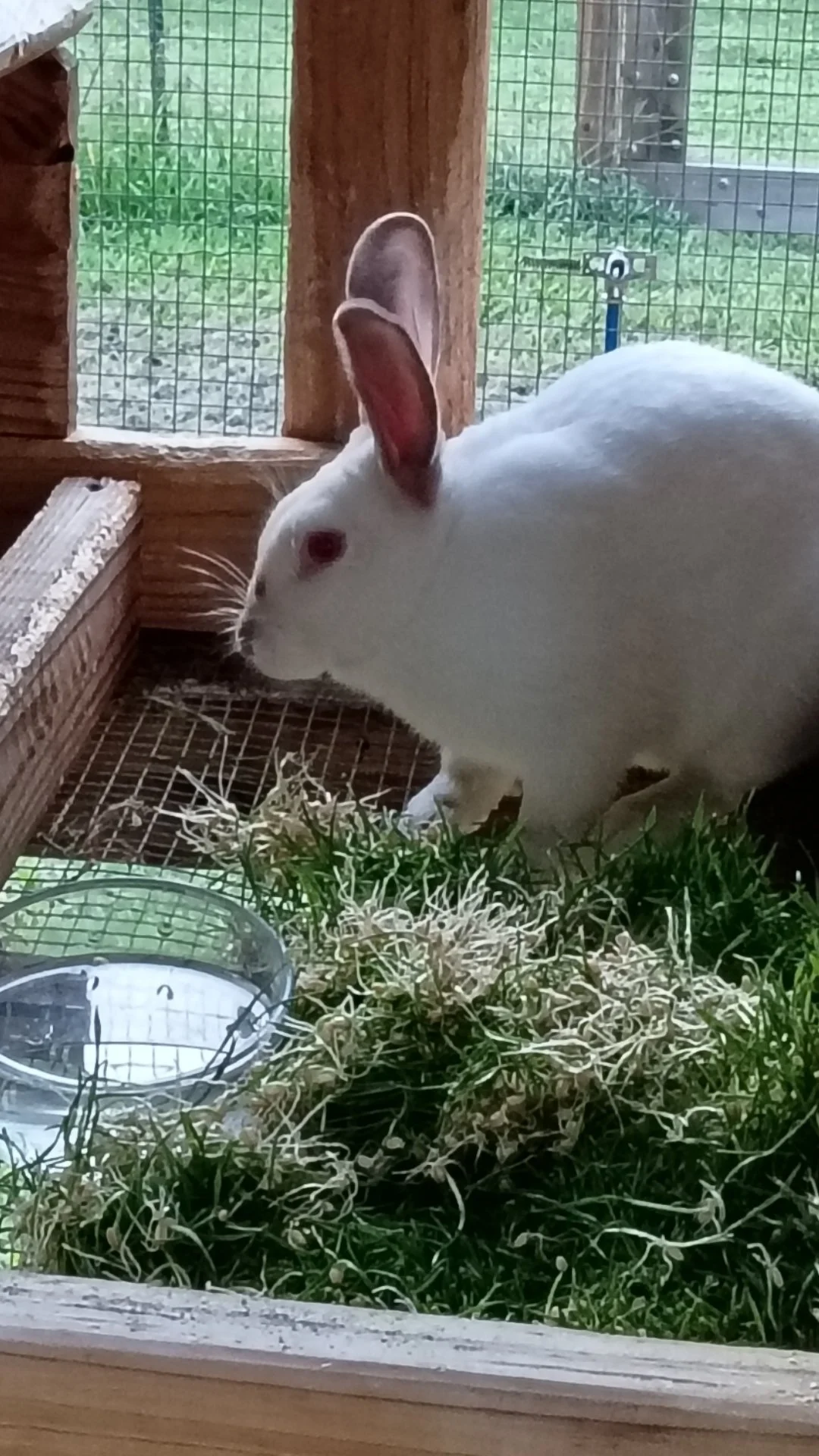
Arnold Puts the Fodder to the Test
Arnold was one of our three taste-testers for this Day-3 batch. Together, the rabbits averaged about 267 grams of fresh fodder each overnight, eating what they wanted and leaving the rest.
All three rabbits were happy, alert, and showed no signs of digestive distress, discomfort, or lethargy. They also ate their normal pellets and timothy hay that morning, which told us the fodder had not disrupted their usual appetites.
We removed the remaining fodder from their pens that morning rather than allowing it to sit longer in the heat.
From this first feeding, we learned:
• They willingly ate the fresh fodder.
• They did not overeat when given a large portion.
• They appeared to regulate their own intake.
• They remained bright, alert, and comfortable afterward.
• They still ate their regular pellets and Timothy hay the following morning.
Because we removed the leftovers, this feeding did not answer whether they would recognize and avoid fodder that had begun to spoil, and honestly, that is not a test we intend to force.
4. What did 267 grams actually mean?
Based on our harvest weight and the amount actually eaten, each rabbit consumed about 267 grams of fresh Day-3 wheat fodder. Because young fodder carries a lot of water, that portion likely represented only about 75 to 85 grams of actual dry plant and grain matter.
Our working estimate suggests that serving still carried a fairly concentrated amount of protein and carbohydrate because much of the original wheat berry was still present. In other words, Day-3 fodder behaves more like sprouted grain with green growth attached than mature forage.
These numbers are estimates, not a laboratory analysis of our actual fodder, but they gave us an important clue: harvest age may change not only how much fodder we grow, but what nutritional job that fodder can perform.
5. We have thoughts…
There are a plethora of studies concerning feeding barley fodder to rabbits, but far fewer concerning wheat fodder. Published studies using barley have successfully tested partial replacement of conventional feed, but some studies have reported less favorable results at higher replacement levels.
That gap in the research is part of what has us thinking more seriously about the wheat fodder growing in our own rack.
6. What is next?
We had to abort the growing cycle at the end of Day 3. The excessive heat, extra moisture, and humidity were not doing us any favors. We had not built the Fodder Watering System yet, and we still had the rack hanging in the confining old bread tray. There is also a possibility that it is in a spot that is not getting quite enough morning sun. It is sitting back in a spot that is more bright shade most of the day, which could be stunting the growth cycle, and it may not be getting enough air circulation. We will reevaluate after this next growth cycle.
The Fodder Watering System is on tap 💦! We will have a video explaining how we built the automatic watering system, why it is not yet self-contained, and what we would change if we rebuild it.