From Scientific Clubs to Ten-Cent Teas to Carnegie
Jefferson, Texas, is a special corner of East Texas that we like to spend time in whenever we get the opportunity. After wanting to visit for more than a decade, I finally got the chance to visit this stunning little gem… the Jefferson Carnegie Library.
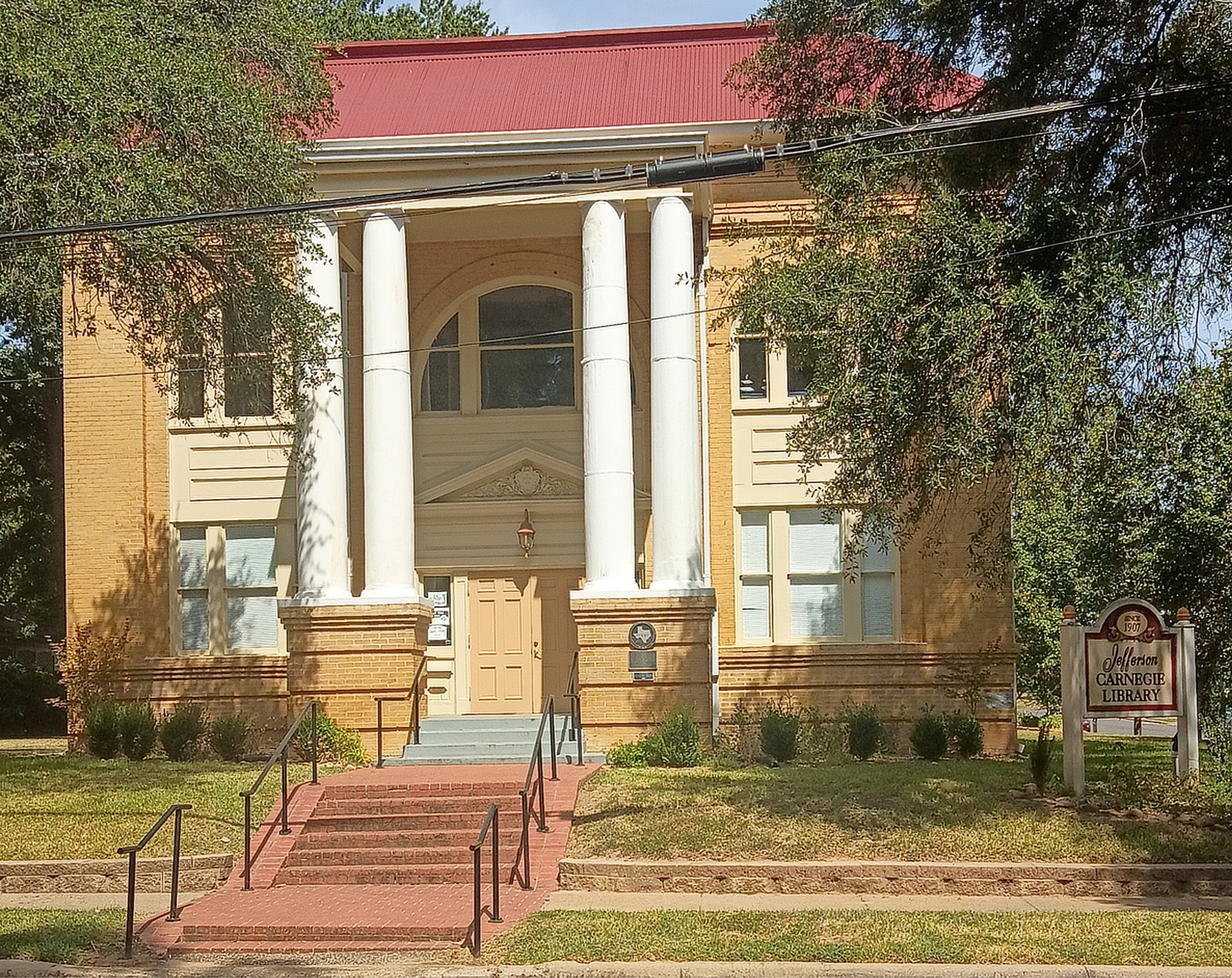
Let me show it to you and tell you a little bit about how Jefferson, Texas, came to have a Carnegie Library...
It did not begin like many of you might imagine.
In fact, this story is embroiled with all kinds of twists and turns, from a front-page newspaper story requesting full community and business support for public “Rest Rooms” at a fee of $30 a month, to a later local tradition associating the early library effort with a YMCA, to the formation of the Jefferson Library Association, book drives, membership fees, and even ten-cent teas.
And much of it happened before Andrew Carnegie EVER entered the story.
First, though, I want to commemorate the determined women of the latter part of the 19th century and the earliest years of the 20th century, and their enterprising and diligent efforts.
The endeavors and labors of these industrious, studied, brilliant women were watched, supported and eventually taken on by the community as a legacy to be carried forward. That community commitment is one of the reasons the Jefferson Carnegie Library is still thriving and remarkable today.
Of the few historic Carnegie library buildings in Texas still currently functioning as community libraries, Jefferson is one of only a handful that have remained in continuous library service, rather than closing for decades and later being returned to library use. That is something to be celebrated as well.
It wasn’t only these persistent women, but Jefferson’s townspeople and Marion County also stepped up to support this Library and helped to keep the doors open throughout the years. In my research, I found that during the Depression Era, the City of Jefferson was taking care of $25 a month of the Carnegie financial obligation and Marion County was taking care of $15 of that obligation. It was times like these, when the city and county stepped up to help each other to keep the doors open, that made all the difference for Jefferson’s Carnegie Library survival.
That, indeed, is something to be commemorated and shared throughout East Texas and beyond.
Before Carnegie: The Library Rooms on Walnut Street
I went digging through the town’s historical records, including newspapers, the plat maps, deeds, written history and the surviving Sanborn Fire Maps that exist. Many of the documents in varying forms and in scattered eras across various decades are missing from the historical record. It is sad but a reality.
There were MANY fires that destroyed documentation in the 1800s. There were major fires in Washington D.C., in 1896 and 1921 that destroyed the Special Census records of 1890 and the bulk of the population schedules. Later, in 1933, Congress chose to destroy what remained rather than attempt to salvage anything that was left. 😩🙄 This act affected not only my research on this project, but the entire Nation in that era and our knowledge of what, where, and who in that decade since it covered the regular Census of 1890 and the Special Census records, as well.
We know the location to look at because there was a little ditty in The Jimplecute that mentions that they are having a “ten cent tea in their rooms on Walnut Street” in order to raise funding for another bookcase. This article ran in The Jimplecute on March 3, 1906 with a follow-up the following week naming the Tea Hostesses.
But WAIT… Who was The Jimplecute?
Few newspapers have weathered the test of time quite as well as The Jimplecute, whose origins are reported to unofficially reach back to 1848, and whose outspoken voice has chronicled Jefferson's triumphs, hardships, and civic ambitions for generations. By 1936, Jefferson's remarkable newspaper history had produced nearly two dozen publications, yet The Jimplecute endured, according to A History of Jefferson, Marion County, Texas, 1836–1936, compiled by Mrs. Arch McKay and Mrs. H. A. Spellings. Others would follow, including the Marion County Courier in 1937 and The Jeffersonian in 1948, but the ol’ Jimplecute remained. Now that's moxie!
Officially founded in 1865 by Ward Taylor, Sr., the newspaper later passed into the hands of his children, Ward Taylor, Jr., and Marion I. “Miss Birdie” Taylor, who operated it during Jefferson's Carnegie Library campaign.
Its peculiar name carried a fittingly ambitious interpretation: “Join Industry, Manufacturing, Planting, Labor, Energy, Capital (in) Unity, Together, Everlastingly,” an explanation preserved in the 1936 history and attributed to Judge W. T. Atkins.
And in another unexpected thread in the historical tapestry, Mrs. Arch McKay, one of the compilers of the very history linked above, had served as a hostess for a Ten-Cent Tea benefiting the Jefferson Library in March 1906. Thirty years later, she helped preserve the history of the very community whose future she had worked to support.
When we say that The Jimplecute has weathered the test of time… unfortunately, that test of time has not been kind to the newspaper’s historical archives. According to current publisher Hugh Lewis, substantial portions of the newspaper's early editions, including entire years and decades, were lost before they could be digitized or preserved. Today, Mr. Lewis is working diligently to ensure that the surviving editions are properly catalogued, digitized, and their original copies entrusted to the Portal to Texas History for safekeeping.
Although these losses have left significant gaps in Jefferson's historical record, his commitment to preserving what remains offers future generations an opportunity to explore the stories, personalities, and events that shaped this remarkable community. We appreciate him and the community’s endeavor’s to maintain a record of their history for folks, like me, that come along later and want to know all about how this fantastical Port town has thrived all these decades.
When you finish reading, take a moment to stop by The Jimplecute’s site and have a gander at the local happenings.💛
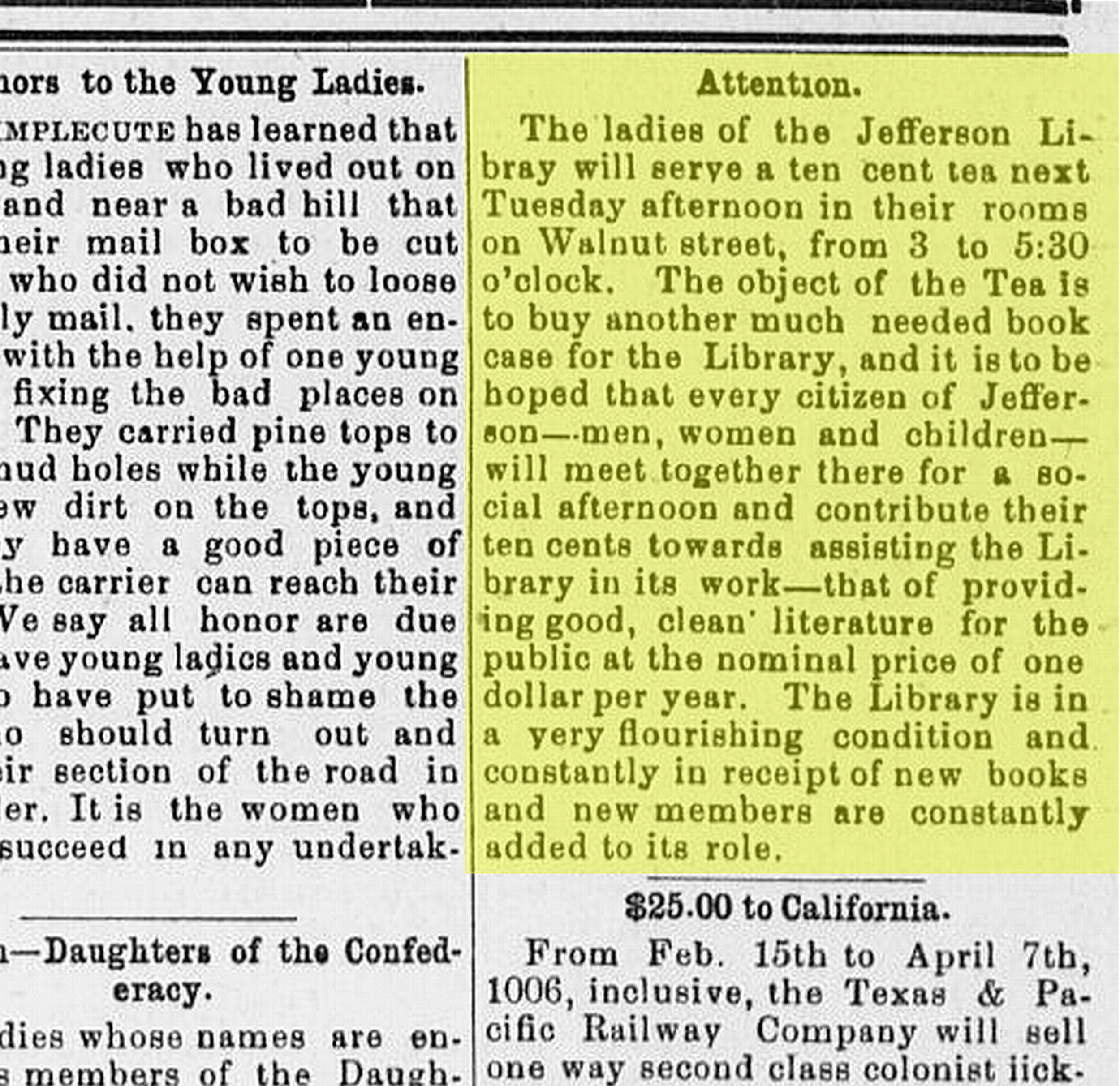
The earliest known Jimplecute notice placing the Jefferson Library rooms on Walnut Street, announcing a ten-cent tea to raise money for another bookcase.
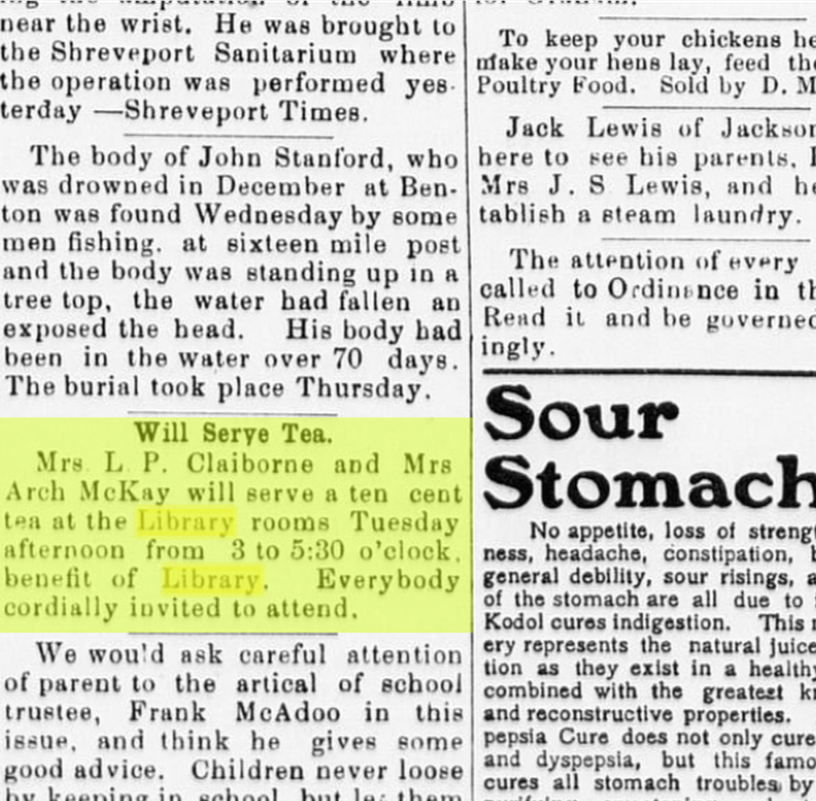
This follow-up notice names Mrs. L. P. Claiborne and Mrs. Arch McKay as hostesses for a ten-cent tea benefiting the Jefferson Library.
I was able to glean information from Jefferson’s surviving Sanborn Fire Maps that do exist from the years 1885-1911 which part of Walnut Street the Library operated from. The Sanborn Maps show that there was a bank in the 202 and 203 section of Walnut at one point.
There is documentation that tells us that the Ballauf family had a private bank and three of the Ballauf daughters worked with their father in his offices at the bank. These women were also heavily involved in the Catholic Church, which is very important and may come into play later.
Between April 1866 and sometime in 1867, the Catholic Church in Jefferson built its first school and library. This could be important…
On March 16, 1867, The Texas Republican ran a short excerpt quoting The Jimplecute:
“The Jimplecute says that a movement is on foot to organize a Scientific Club, in Jefferson, in connection with a public library and gymnasium. Glad to hear it.”
The Texas Republican (Marshall, Tex.), Vol. 18, No. 31, March 16, 1867, quoting The Jimplecute, Jefferson, Texas. University of North Texas Libraries, The Portal to Texas History.
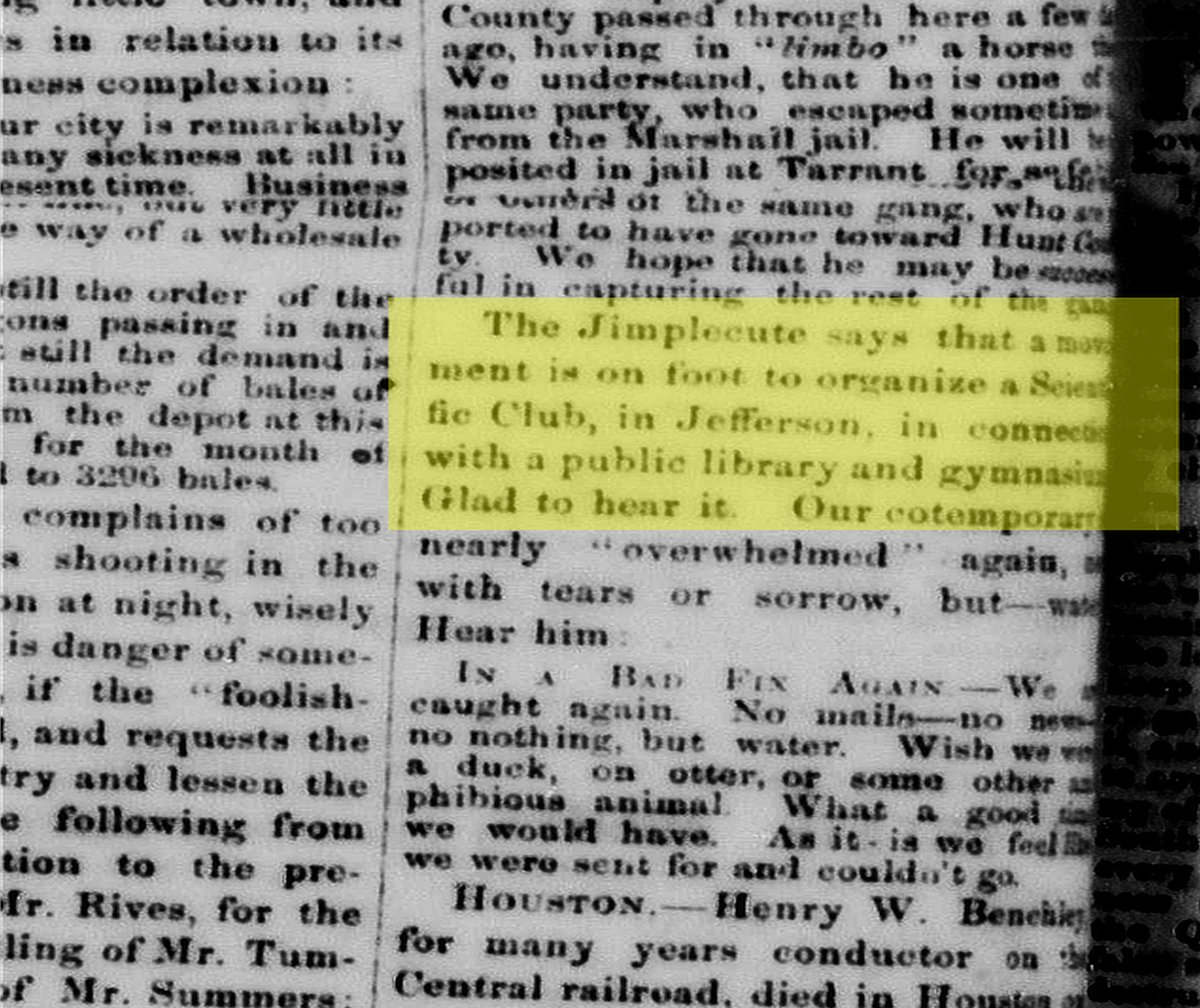
In 1867, The Texas Republican repeated The Jimplecute’s report that a movement was underway in Jefferson to organize a Scientific Club in connection with a public library and gymnasium.
Could they have been referring to the school and its construction in The Jimplecute and The Texas Republican in 1867? Did later readers misconstrue this to be a YMCA? We may never have these answers, only questions rolling around in our minds…
The interesting thing is that there was an R. Ballauf and Co. on the same street for a while, and the Ballauf women were very involved within their Catholic societal world and the goings on there, while not so much with the Jefferson societal goings on…
At the same time, we have unofficial reports of a Ladies Auxiliary, associated with a reported men’s club, taking on the debt of the failed men’s club (maybe YMCA) and reforming themselves into the Jefferson Library Association… but let’s talk about that men’s club for a minute.
A 1981 Jeffersonian historical article is the earliest source I have located that identifies the predecessor organization as a YMCA. It states that the ‘Ladies Auxiliary of the Jefferson YMCA’ took on furnishings, books and a $50 debt from the failed YMCA club before reorganizing as the Library Association, but it does not cite an actual YMCA charter, roster, annual report, newspaper account, minutes or other primary documentation for that identification. Because Jefferson is also absent from the official YMCA yearbooks that I reviewed for 1890-1902, I treat the YMCA claim as a later secondary tradition rather than a proven nineteenth-century fact.
I found Marshall’s YMCA charter, Wiley College’s YMCA, Paris, Texas and other Texas associations, like the Railroads, at various times. But I didn’t locate Jefferson in the Young Men’s Christian Association (YMCA) official yearbooks that I reviewed. The yearbooks prior to 1890 do not give the clubs by City or State; they list the members by individual name, and I did look in some of the years for prominent names of the city such as Rowell, Taylor, Terhune, Ballauf, Meyer and others but did not find any.
It is possible that there was a misunderstanding, or that the group was not able to get the requirements to complete the official charter, or any myriad of things… or it is possible that I missed a piece of research. It could even be that the above snippet from those few lines in that newspaper quoted by The Texas Republican in 1867 was translated into ‘YMCA’. It would not be a hard stretch of the imagination at all. We may never truly know.
It is my supposition that a core group of men and women was working together to bring refinement to the Piney Woods from the earliest days and toward a library even as early as 1867.
For instance, Allen Urquhart donated part of the land that the Catholic school and library were built on, and forty years later penned the correspondence that helped secure the grant money from Carnegie for the Jefferson Carnegie Library.
Coincidence??
Another Kind of Club…
There was a club in Jefferson before there was even a hint at the possibility of a Carnegie Library. In October of 1881, at the home of Mrs. W. B. Ward, there was the first ever meeting of what would later become known as the 1881 Club.
Long before Jefferson had a public library, local men and women were already gathering for a Chautauqua Circle; basically, a hometown version of adult college where they studied literature, history, science and current events together.
And THAT matters, because it set the precedent later that Jefferson already had a culture built around books, learning and organizing civic education many decades before Carnegie ever entered the picture.
This type of activity was something that the Carnegie Organization looked at when they were reviewing applications for the grants they gave out for their library buildings all over the world. These were the criteria a community had to meet:
The library had to be free and public.
The community had to provide a suitable building site.
The community had to commit to maintaining the library on a permanent basis.
The customary maintenance pledge was generally at least 10% of Carnegie’s grant amount per annum, typically supplied through tax support. Jefferson’s initial grant was for $7,500 and THEN there was an additional $2,500 approved later. SO, for Jefferson, that meant at least $1,000 in support per year when Carnegie’s grant reached $10,000*.
The community had to show that it was capable of the support needed, which Mr. Urquhart supplied in their correspondence (See link below). The application asked questions about the population, whether the city already had an existing library, the number of books they had, annual circulation, their current library’s quarters, finances, municipal tax capacity. There were even questions about the proposed site for the new library and if money had already been raised toward that building venture.
When $7,500 Wasn't Quite Enough
On May 18, 1906, Andrew Carnegie offered Jefferson $7,500 toward the construction of a free public library, provided the city supplied a suitable building site and committed $750 annually toward its maintenance.
But building a library proved a little more complicated than anyone had anticipated.
Disagreements over the proposed site delayed the project, and revisions to the building plans complicated matters further. When construction bids finally arrived, the lowest was $8,750, exceeding Carnegie's original offer.
Allen Urquhart again appealed to Carnegie for additional funding through correspondence with his secretary, James Bertram.
On May 2, 1907, Carnegie's office agreed to increase the gift to $10,000, provided Jefferson increased its annual maintenance commitment accordingly.
The City Council accepted the terms on May 8, raising its annual pledge from $750 to $1,000.
What began as a $7,500 promise had become a $10,000 commitment, secured through the persistence of Jefferson's library supporters.
The most fascinating part is that ALL of this correspondence and documentation can be viewed in the Carnegie Corporation of New York Records, preserved in Columbia University’s digital collections. The Jefferson Carnegie Library correspondence can be found here.
*Carnegie’s money was intended for the construction of the building, not for purchasing books, maintaining the collection, or funding ongoing operations. Those responsibilities rested with the community.
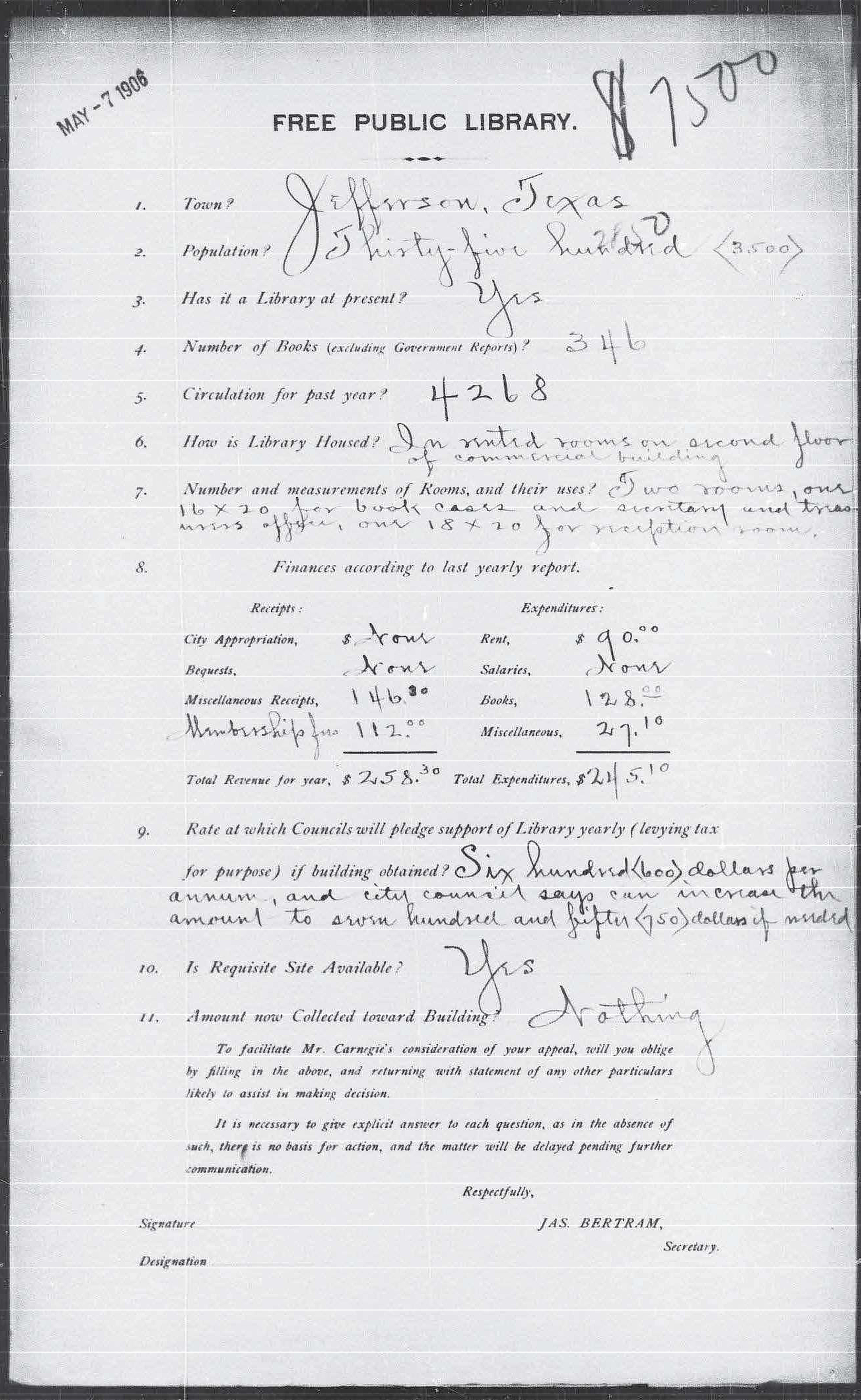
This fascinating 45-page collection of historical correspondence offers a charming glimpse behind the scenes of Jefferson's Carnegie Library. Beginning with exchanges between Allen Urquhart and James Bertram, Andrew Carnegie's private secretary, the documents trace the library's early ambitions and the challenges that followed.
The correspondence also includes the rather spirited objections of R. L. Crute to moving pictures being shown in the library auditorium, along with discussions in the 1930s about turning the building over to the local school. Spanning decades of civic pride, determined personalities, and occasional squabbles, these original records reveal that the story of Jefferson's Carnegie Library was anything but uneventful.
Source: Carnegie Public Library, Jefferson, Texas. Carnegie Corporation of New York Records, Columbia University Libraries, Rare Book & Manuscript Library. 45-page archival collection.
The Women Who Built a Library Before Carnegie Arrived
A New Century, A New Approach
Now, this newly formed Library Association is reported to have inherited 30 books from Mrs. Lelia Sedberry, and she had been installed as the new Library Association President…
And Mrs. Sedberry, she was a formidable resident in Jefferson by 1902.
Lelia Shortridge George Sedberry might not have been a Jefferson native, but that mattered not a whit to her. 🫶 She had been raised in Alabama by Judge George D. Shortridge and his wife, and the Judge was not only a prominent legal man in Alabama, but he was a political man, as well, and well-connected. Her sister, Louisa, had married the man who would become the Chief Justice of the Texas Supreme Court.
Lelia was not a simple woman, nor an uneducated woman. We can see just from her “Rest Rooms” Proposal that she was industrious and had a sharp business mind. She was more than ready to help propel that Library into the FOREVER category.
Innovative Ideas ~ Rest Rooms, 10¢ Teas and more
The Rest Rooms
There are many misrepresentations surrounding the ladies’ attempts to raise funds for their new library. Fortunately, there are both historical documents and contextual clues that tell us what they did and how they got from go to no and a heck yeah from Carnegie himself; that is a wild ride, so buckle up, friend.
These women were brave and had little compunction about going against silly societal norms when doing so might be of great gain for the community and business owners alike.
But context is key.
Words didn’t exactly mean in 1905 what they do in 2026, and before we trudge any further down this rabbit hole, there is a bit of linguistic housekeeping we need to do… And I am as big a fan of etymology as I am history!
Today, pretty much anyone asking for the “restroom” is asking for the toilet. That is not necessarily what an American, or any person speaking English meant by “Rest Rooms” in 1905.
Etymonline.com dates the recorded use of ‘rest room’ in this literal sense to 1887, without giving any other context on exactly where it was first put into usage. There are a couple of earlier dates noted, but I have not found any credible documentation strong enough to rely on them at all. There are newspapers that have the term in use as a hyphenated word and as two words to complete the concept in the 1890s.
By the opening years of the twentieth century, Ladies’ Rest Rooms had become part of a growing civic movement to provide respectable public spaces where women coming into town, whether they traveled by train or by horse and buggy, could sit, tend to their children, read, visit, refresh themselves, and wait while conducting business and shopping.
Some rest rooms included lavatory facilities, just as libraries, hotels, clubs, and other public buildings do today. But the lavatory was not the institution.
The familiar American use of “restroom” as a euphemism for a toilet came later.
That difference in language matters because, read through twenty-first-century eyes, modern accounts of Lelia Sedberry’s 1905 proposal can leave an almost comically inaccurate impression: that the president of the Jefferson Library Association wanted to open public bathrooms and somehow use them to support the library.
Then you read what Lelia actually proposed. And suddenly, the “Rest Rooms” look nothing like bathrooms at all.
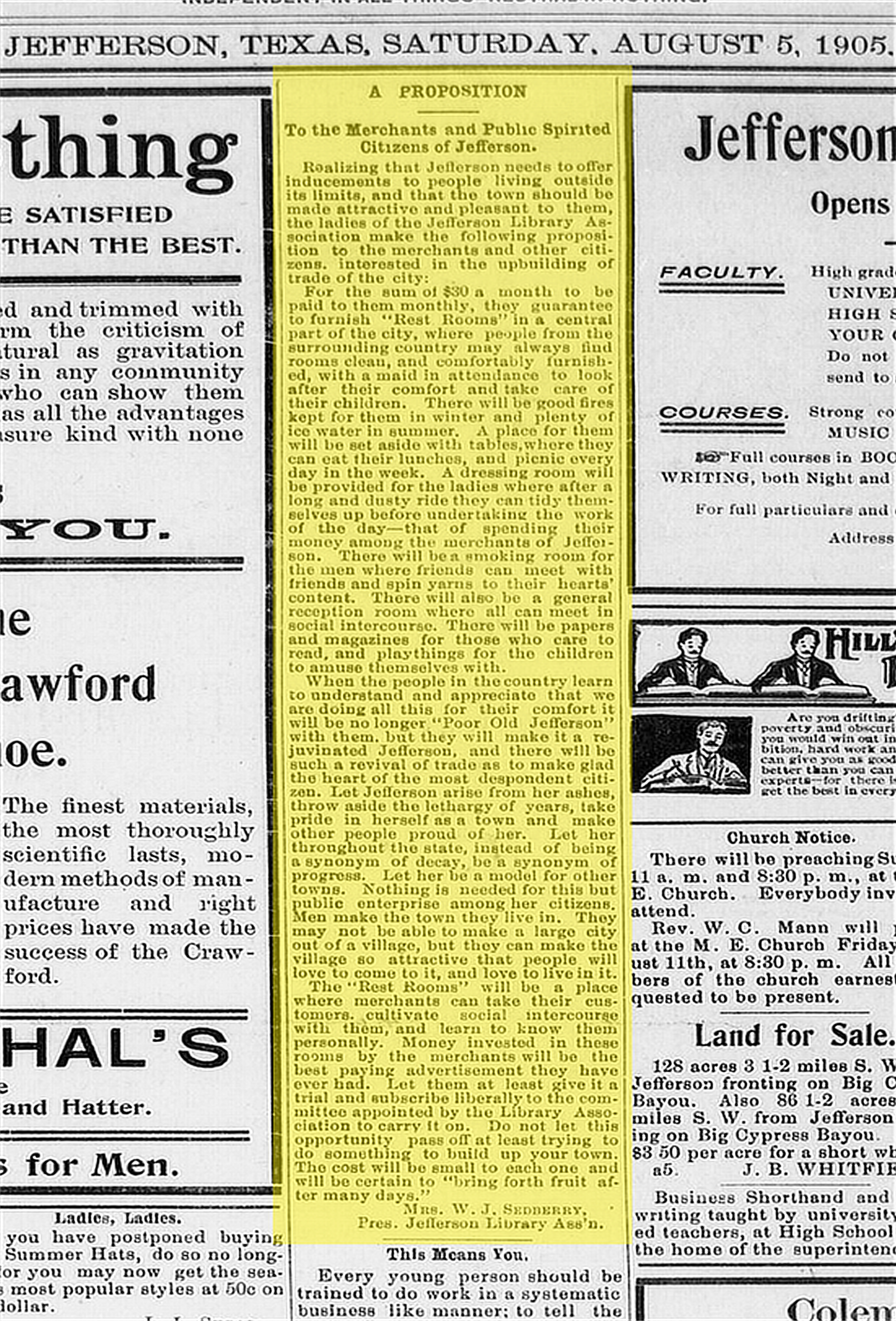
A PROPOSITION
To the Merchants and Public Spirited Citizens of Jefferson.
Realizing that Jefferson needs to offer inducements to people living outside its limits, and that the town should be made attractive and pleasant to them, the ladies of the Jefferson Library Association make the following propositions to the merchants and other citizens interested in the upbuilding of trade of the city:
For the sum of $30 a month to be paid to them monthly, they guarantee to furnish “Rest Rooms” in a central part of the city, where people from the surrounding country may always find rooms clean, and comfortably furnished, with a maid in attendance to look after their comfort and take care of their children. There will be good fires kept for them in winter and plenty of ice water in summer. A place for them will be set aside with tables, where they can eat their lunches, and picnic every day in the week. A dressing room will be provided for the ladies where after a long and dusty ride they can tidy themselves up before undertaking the work of the day, that of spending their money among the merchants of Jefferson. There will be a smoking room for the men where friends can meet with friends and spin yarns to their hearts' content. There will also be a general reception room where all can meet in social intercourse. There will be papers and magazines for those who care to read, and playthings for the children to amuse themselves with.
When the people in the country learn to understand and appreciate that we are doing all this for their comfort it will be no longer “Poor Old Jefferson” with them, but they will make it a rejuvinated Jefferson, and there will be such a revival of trade as to make glad the heart of the most despondent citizen. Let Jefferson arise from her ashes, throw aside the lethargy of years, take pride in herself as a town and make other people proud of her. Let her throughout the state, instead of being a synonym of decay, be a synonym of progress. Let her be a model for other towns. Nothing is needed for this but public enterprise among her citizens. Men make the town they live in. They may not be able to make a large city out of a village, but they can make the village so attractive that people will love to come to it, and love to live in it.
The “Rest Rooms” will be a place where merchants can take their customers, cultivate social intercourse with them, and learn to know them personally. Money invested in these rooms by the merchants will be the best paying advertisement they have ever had. Let them at least give it a trial and subscribe liberally to the committee appointed by the Library Association to carry it on. Do not let this opportunity pass off at least trying to do something to build up your town. The cost will be small to each one and will be certain to “bring forth fruit after many days.”
Mrs. W. J. Sedberry,
Pres. Jefferson Library Ass'n.
After reading her wonderfully written proposal on the front page of the August 5, 1905 Edition of The Jimplecute, an entirely different picture begins to emerge.
Now, take a moment and again, put that into context… A woman was able to convince a rather prominent pair of newspaper editors to run her PROPOSAL for Rest Rooms on the FRONT PAGE, above the fold, in 1905… DAMN!
And she asked the businesses for $30 a month, which translates to roughly $1,550-ish a month in 2026 money. That was hardly chump change.
That is ambition.
For her town. Her present and their future.
That was vision.
You must wonder if she had travelled and encountered another place like this that made her see something that Jefferson could aspire to, as well.
What Lelia Sedberry was describing sounds far more like a public civic club or hospitality center than anything we would recognize today as a “restroom.”
There would be comfortable rooms where visitors could rest. Women could tend to their children and freshen themselves before shopping. People coming into Jefferson from the surrounding countryside would have a welcoming place to gather. And perhaps most revealing of all, Jefferson’s businessmen could sit down with their customers, visit with them, and become better acquainted.
That is not a bathroom.
That is hospitality and relationship building.
Frankly, that is Marketing 101.
And it appears to have been part of something even larger.
I haven’t found any surviving evidence telling us exactly where Lelia Sedberry first encountered the idea of a public Rest Room for women. But by 1905, she certainly had plenty of opportunity to know the concept existed.
Her husband’s family had strong ties to New Orleans, where a ladies’ rest room was already part of the L&N passenger station by 1902. We know that Jefferson and New Orleans had been in an economic rivalry in its steamboat heyday, in an 1876 Jimplecute they seem to be pining the days of healthy economic competition between the two port cities.
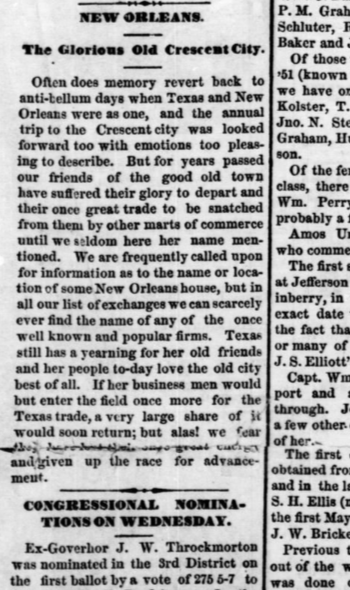
An 1876 Jimplecute editorial looking back on Jefferson’s longstanding trade relationship with New Orleans and lamenting that the Crescent City had allowed much of its Texas commerce to be captured by competing markets.
The paper urged New Orleans merchants to re-enter the Texas trade, noting that Texans still held considerable affection for the city.
Source: “New Orleans: The Glorious Old Crescent City,” The Daily Jimplecute (Jefferson, Texas), September 1, 1876, Vol. 5, No. 1, p. 2, col. 1. The Portal to Texas History, University of North Texas Libraries.
Across Texas, women’s clubs and civic organizations were beginning to establish similar facilities and newspapers were openly discussing them as a way to make towns more welcoming to women coming in from the countryside to shop. And in Austin, where Lelia’s sister Lou lived as the wife of Texas Supreme Court Chief Justice Reuben R. Gaines, a downtown business was advertising its own Rest Room by July 30, 1905.
Six days later, on August 5, Lelia Sedberry’s remarkably detailed proposal for Jefferson’s Rest Rooms appeared on the front page of The Jimplecute.
Did she see the one in Austin while visiting her sister? Did she read about other Texas towns experimenting with the same idea? We do not know.
But Lelia was educated, well connected and deeply involved in Jefferson’s civic life. It’s absolutely within the realm of possibility to believe that she was paying attention to what other communities were doing.
And if she had seen one Rest Room in operation, read about others succeeding across Texas, and then encountered another in her sister’s city, it is not difficult to imagine Lelia thinking:
🤔 Jefferson needs this, too.
What makes her proposal so interesting is that she did not merely suggest a place for women to stop. She understood the larger value of the idea. Her plan considered women arriving after long trips, children needing care, seasonal comfort, a place to freshen up, and, importantly, the money those women would spend with Jefferson merchants once they were comfortable enough to stay in town.
Whether Lelia borrowed the idea, improved upon it, or simply recognized a movement whose time had come, she appears to have understood something important before many others did: making a town more comfortable for women was not merely an act of hospitality.
It was good business.
The ladies were not simply trying to raise enough money to keep a handful of books on a shelf. They were trying to create a place that would draw people into Jefferson, encourage them to stay, connect them with local businesses, and help restore some of the activity and vitality the city had lost.
In modern terms, the closest comparison might almost be a publicly accessible country club, community parlor, visitors’ center, and business lounge rolled into one.
Except this one was not intended to be exclusive. It was intended to be inclusive.
The hope that Lelia seemed to express in her front-page missive to the people and business owners on that Saturday Proposal in The Jimplecute was intended to bring Jefferson, folks from the outlying communities, and even random strangers passing through on the trains together. It was meant to truly develop and maintain connection, neighborhood, fellowship and cohesion within the community and across the business networks, bringing Jefferson together to build back the glory that it once knew.
When the Rest Rooms proposal failed to gain the support that they had hoped for, the women did what they would do repeatedly over the next several years: they changed tactics.
If Jefferson was not ready to underwrite their ambitious ‘civic center’, they would raise the money a single dime at a time.
The 10¢ Teas
This charming announcement from The Jimplecute, published March 10, 1906, offers a glimpse into the Jefferson Library's beloved Ten-Cent Teas.
Mrs. L. P. Claiborne and Mrs. Arch McKay invited the community to gather in the library rooms on Tuesday afternoon, from 3:00 to 5:30, for a modest fundraising event benefiting the library. These gatherings were more than an opportunity to raise a few dollars. They brought Jefferson's citizens together in support of an institution the women were determined to sustain, one dime at a time.
Next came the Ten-Cent Hostesses.
And there is something about this idea that deserves more attention than a turn on a dime.
The hostesses were not simply two women chosen to pour tea. They represented two different generations of Jefferson women.
We ought to give this a moment’s thought… about what that accomplished.
The older generation brought its established relationships, experience and influence within the community. The younger generation was brought directly into the work, introduced to the people supporting it and given a role in carrying the effort forward.
The library was no longer dependent upon one woman, one group of women or even one generation of women. They were creating continuity.
Whether that intergenerational legacy was deliberately engineered or simply the natural way these women organized themselves, the result was the same. The responsibility for the library was being passed from one generation to the next while they worked side by side.
And it worked.
The women who started this effort would not live forever. Neither would Lelia Sedberry.
But the idea did.
More than a century later, the Jefferson Carnegie Library is still serving the community those women fought so hard to bring into it.
Perhaps the greatest thing they raised at those Ten-Cent Teas was not money at all… They raised the next generation of women who would keep the library alive, and the one after that, and the one to follow that. They created true legacy.
The NEW Library on Walnut Street
I went back to the surviving Sanborn Fire Maps and started looking on Walnut Street for any reference to buildings that had an upper floor where there was a designation of a club or meeting room or anything of that sort. I was looking and hoping to find something linked to a building that was still in existence.
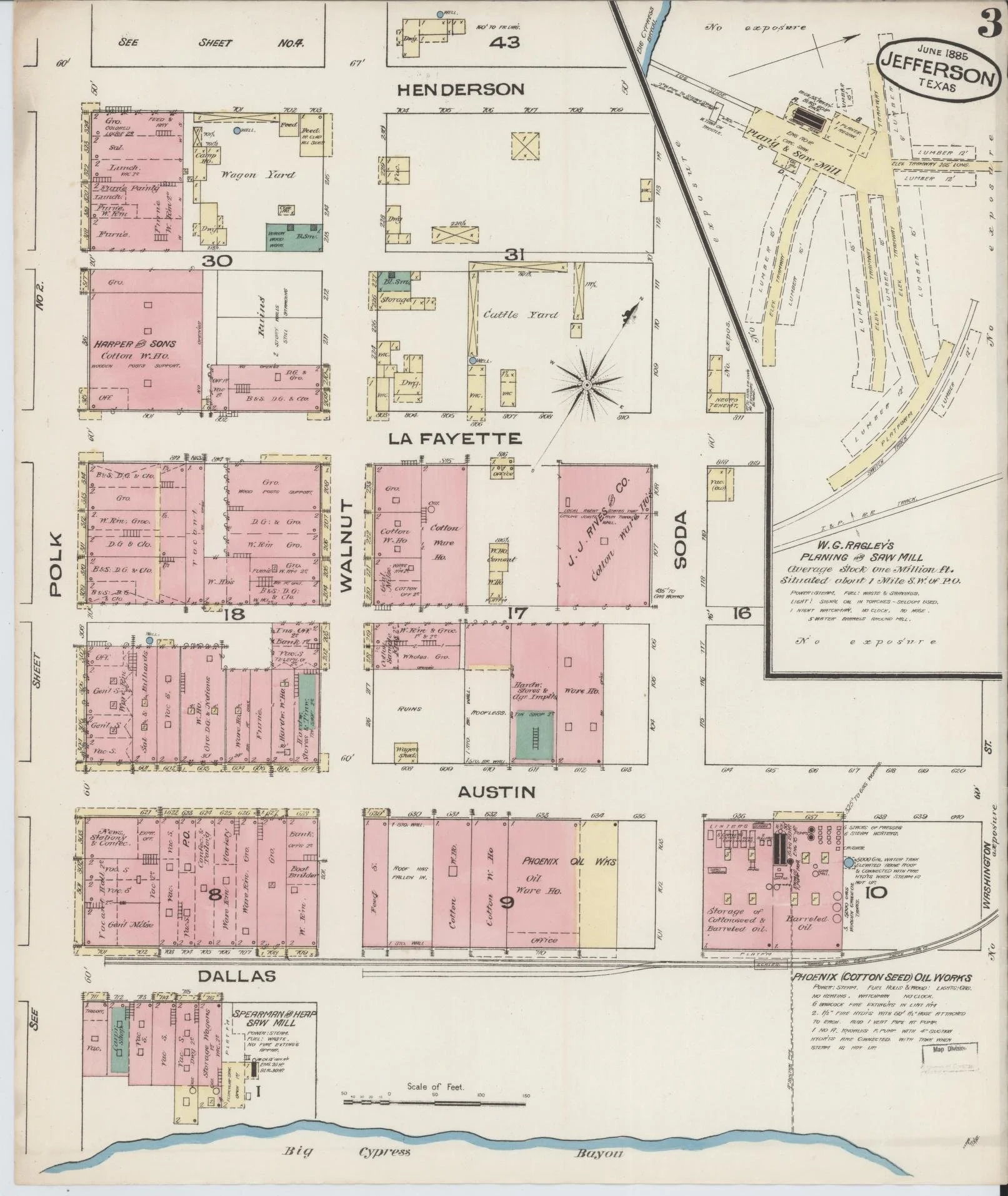
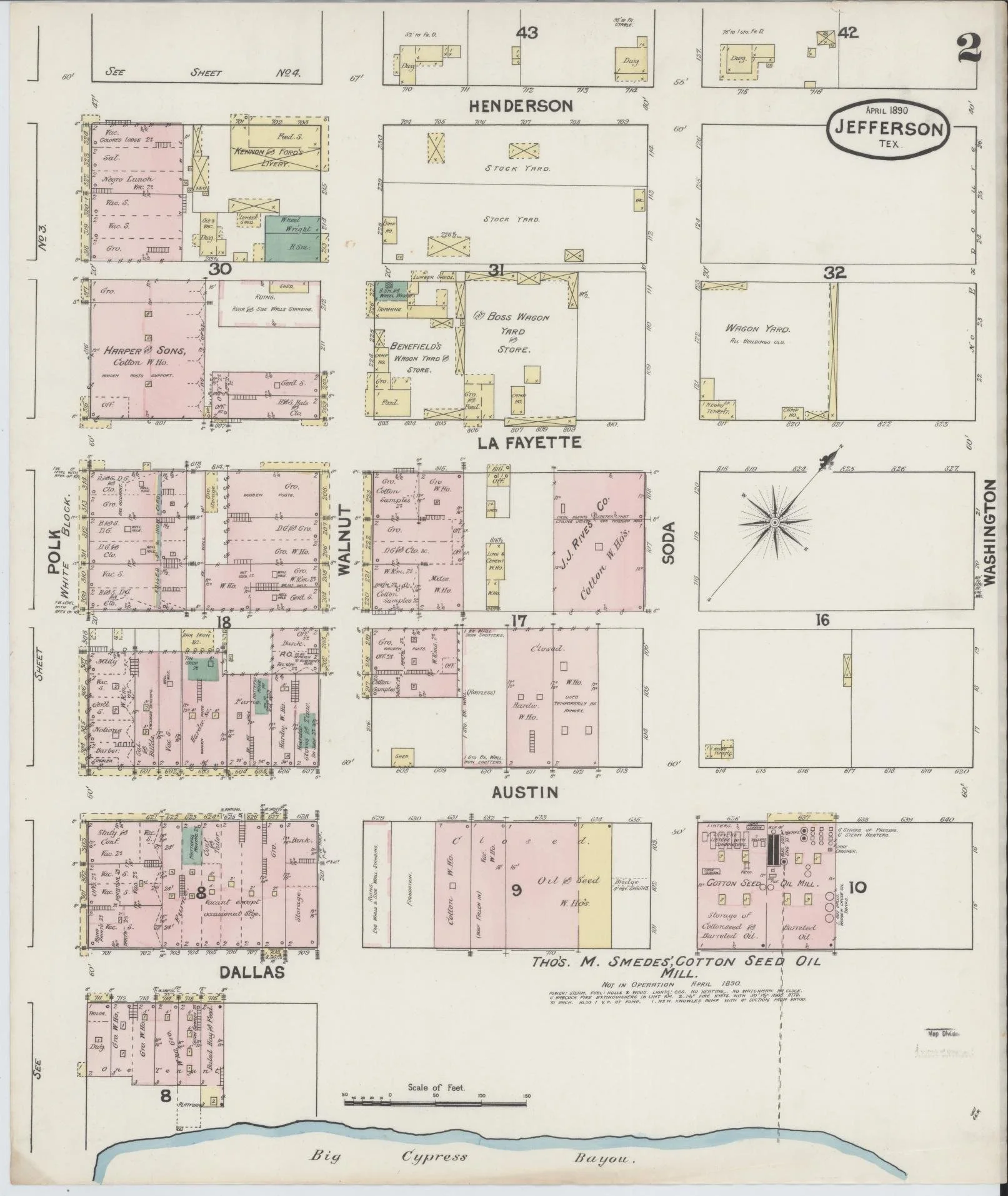
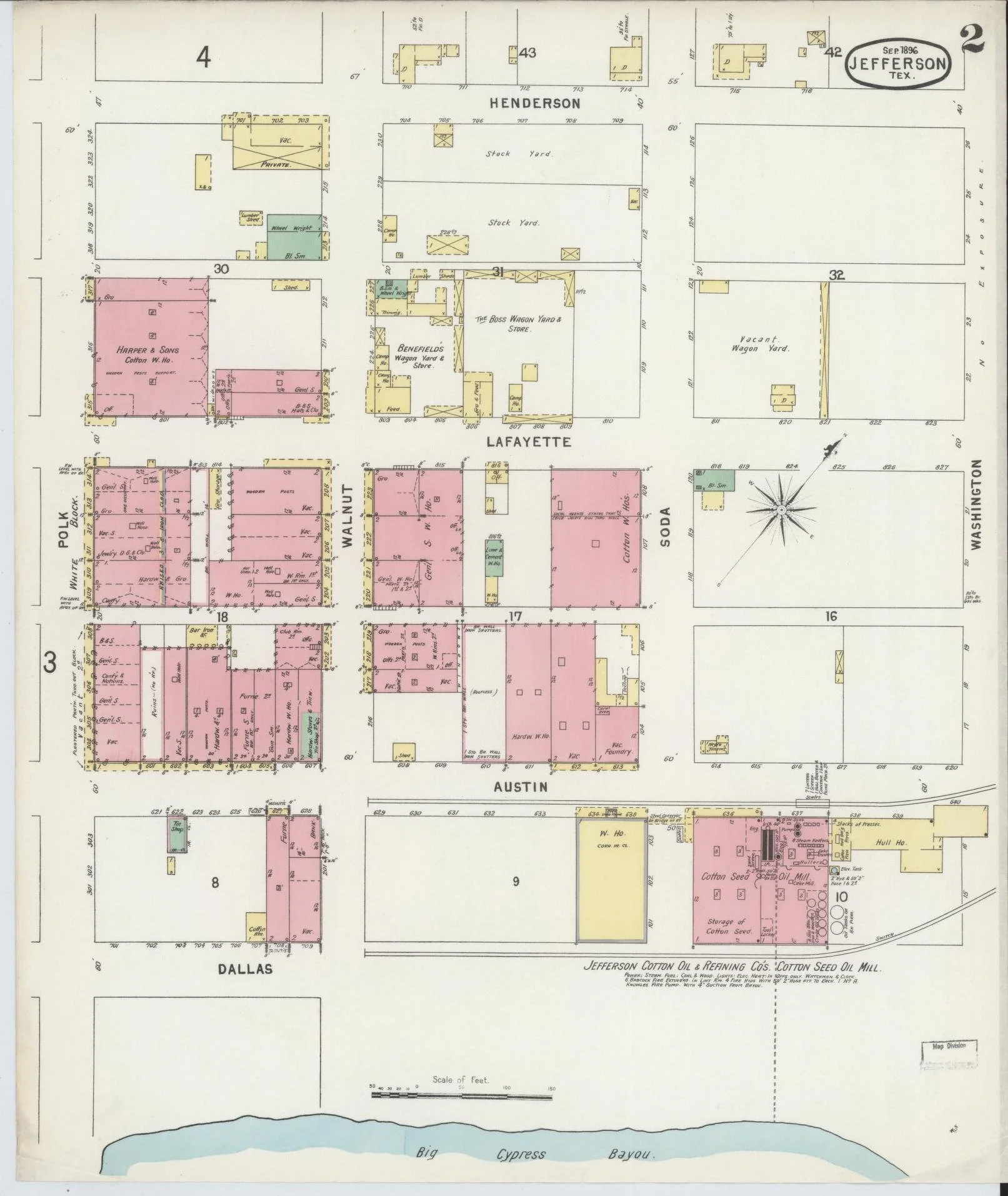
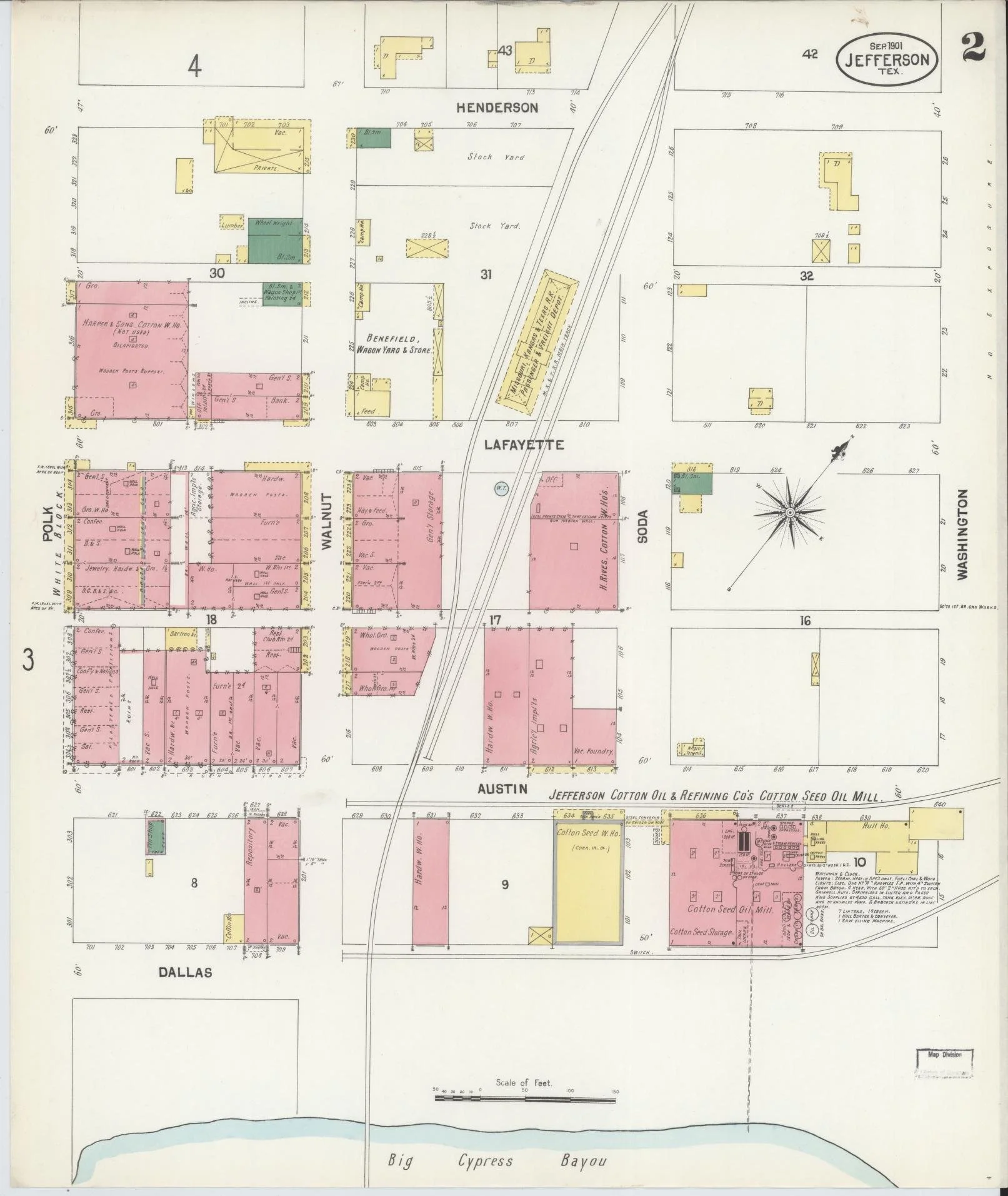
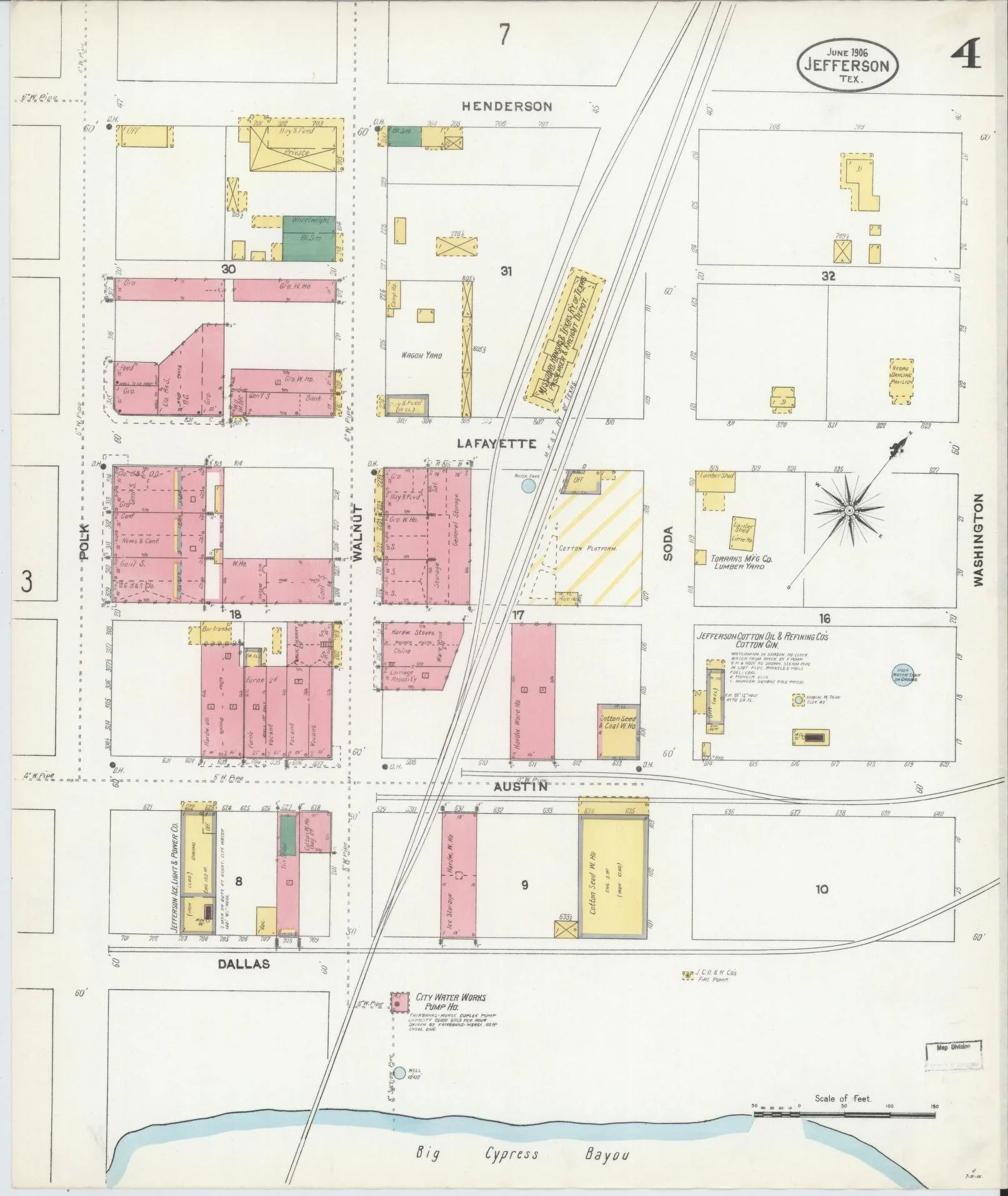
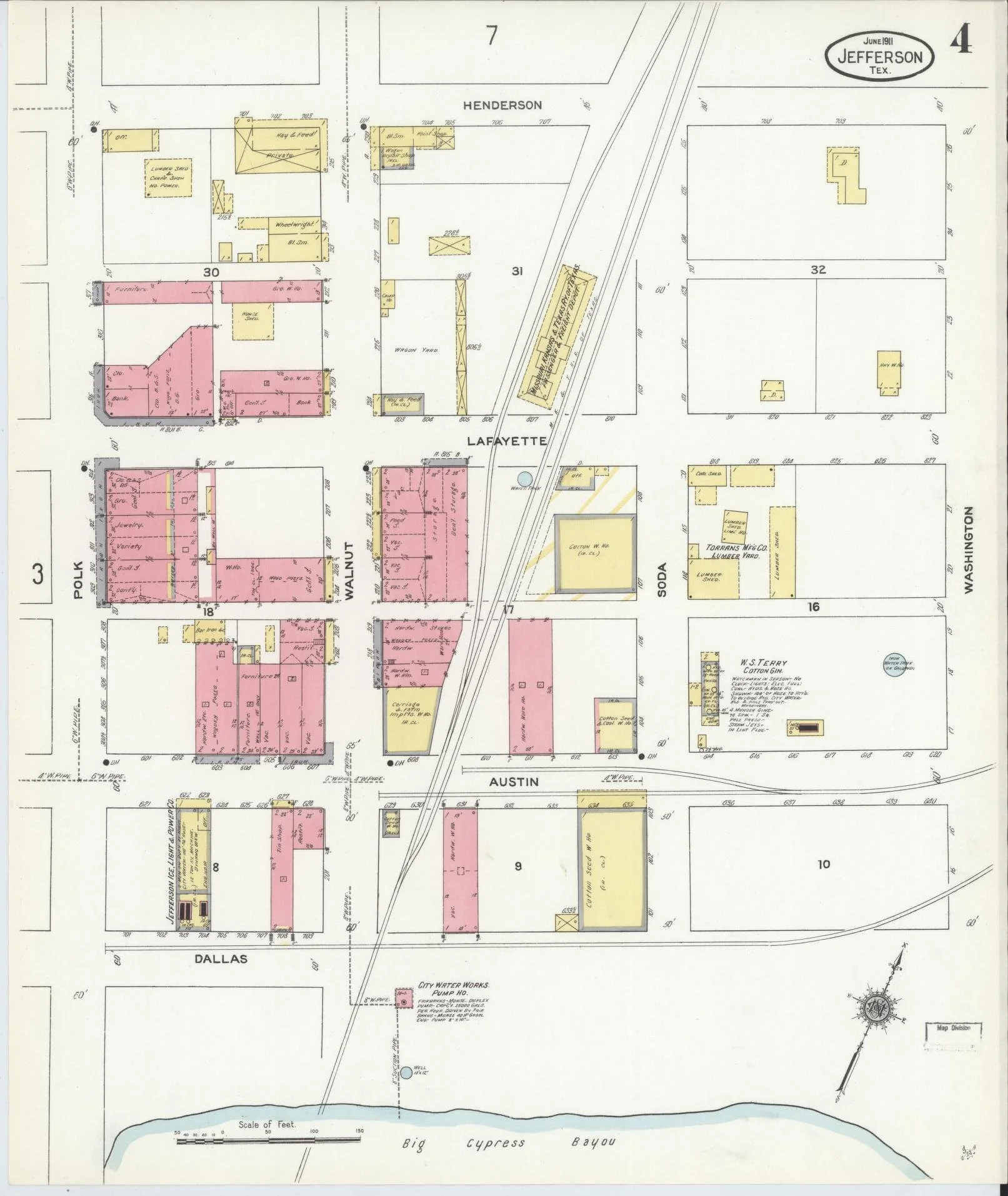
The reason I was looking for that reference is because until the library became ‘official’ in 1902-03, it would have been using space either by renting or leasing space OR someone would have been the benefactor and loaned the space to the ladies in an unofficial ‘non-library’ capacity.
Either way, because Jefferson had been subjected to no less than seven major fires that had caused what we would consider catastrophic damage today in the downtown business district, the Sanborn Fire Maps from about 1885-1911 are fairly meticulous. It is pretty easy to see what types of businesses were occupying which buildings. Now, these ladies didn’t wait very long before they found a new home for their three rooms of furniture and 30 books, and that home, it seems, was 111 N. Walnut Street.
I found that in 1890 the Sanborn Maps marked the building that is now 111 N. Walnut Street, was marked as ‘Bank’. Then, on the upper floor of the same building, you can see in subsequent years, ‘Club’… but, in the 1906 map, it is designated ‘Public Library’. 🫶🎉 Jackpot!
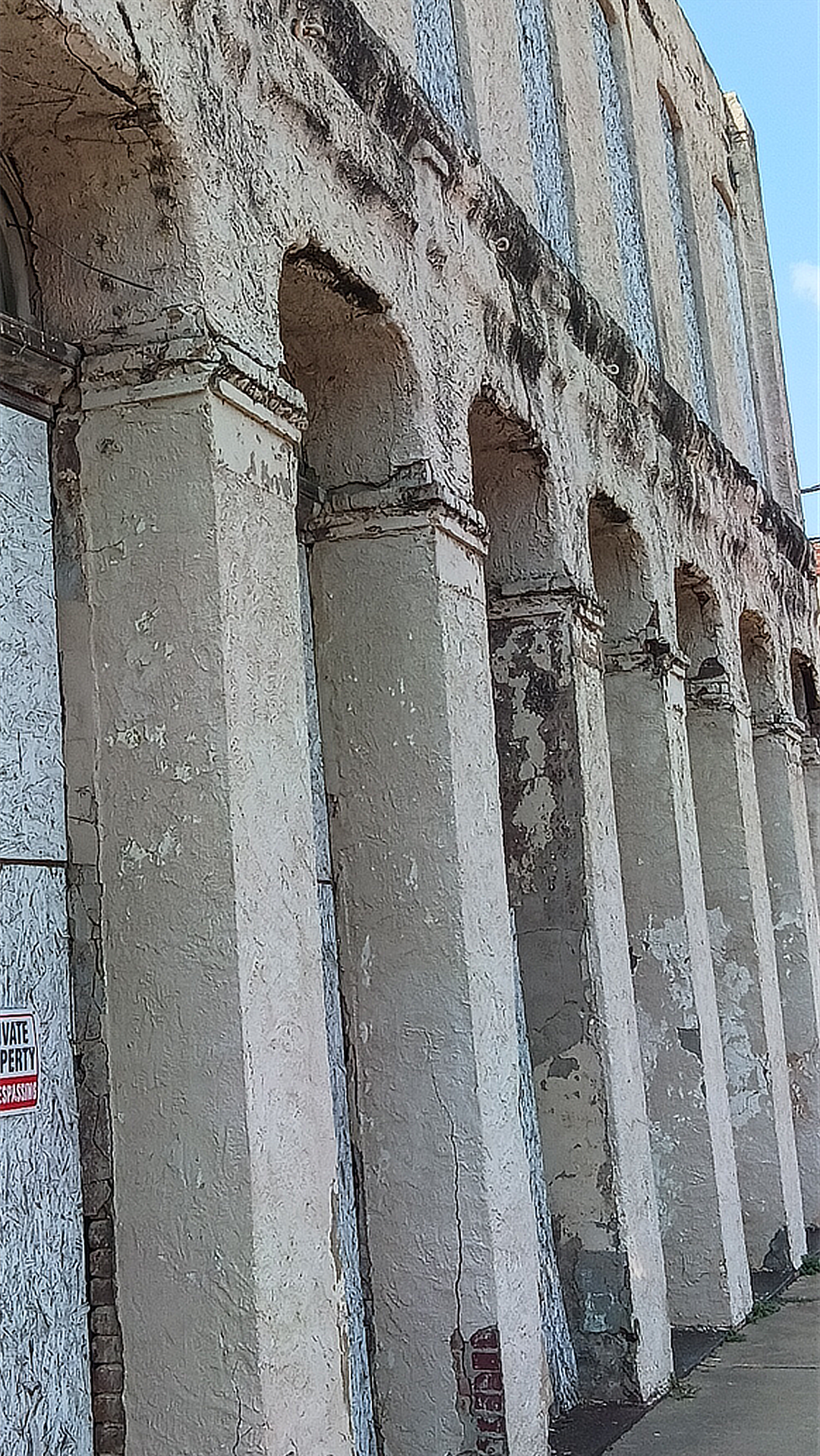
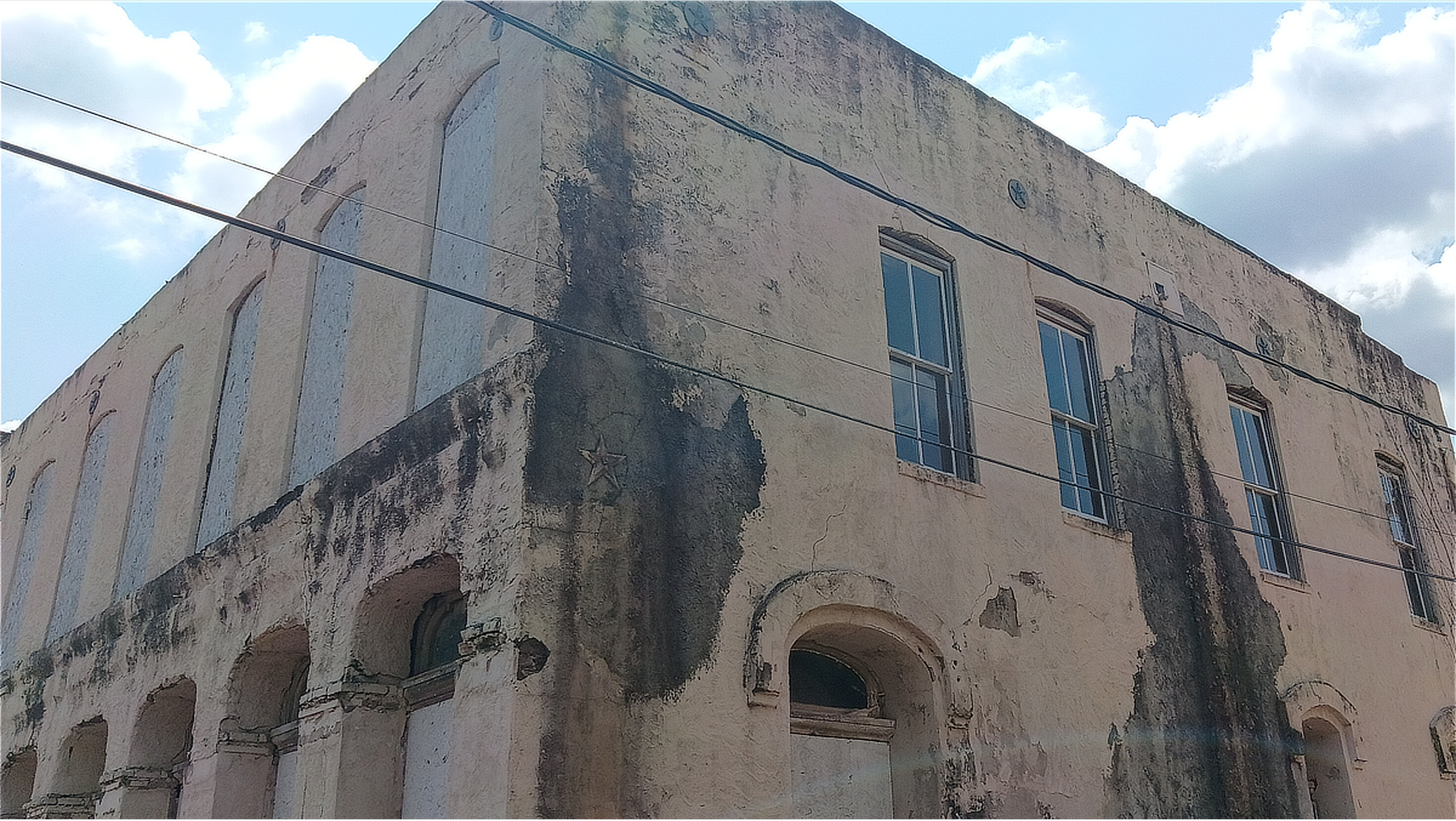
I spent weeks combing archives, both online and through deed records, going all the way back to the 1870s, attempting not only to trace the building’s ownership history but also glean a better picture of the life lived inside the walls… Oh! I do wish I could lay my ear upon those walls and hear the stories!
The Citizens Savings Bank was built in 1871 on land that was owned by W.Q. Bateman. He was not one of the twelve founders/directors of the bank, but he was the bank President. I found in my research that the bank got into some trouble, BIG trouble. In 1879, they were caught speculating cotton futures… The first recorded transaction was something like $250 against 100 bales of cotton, which controlled more like $5,000 worth. They kept on and on like this with these speculative transactions and they were fine (winning) until they weren’t (until they lost, big).
This case ended up lasting NINE years and making it to the 1890 New York Court of Appeals. While the Citizens Savings Bank was totally in the wrong, they argued that their charter didn’t allow for them to speculate on futures and trade on the grounds of ultra vires, that even though their cashier had done this, the bank itself had no legal powers to bet the futures, so there was no way to enforce the deal against the bank itself. AND THEY WON!
We don’t really know firsthand what happened after that, but the bank did fail officially July 7, 1891, and in fact close its doors. T.J. Rogers became the assignee, and the liquidation of the bank’s assets began.
____
During all of this chaos, the ladies were still doing what they do… working on bringing refinement to this port town. These ladies were a tenacious bunch too! They had endured so much by this point!
Something else we can see on the Sanborn Fire Maps as the years progress is that by the time we get to the 1906 images, we can clearly see the gray lines around many of the buildings. Those denote that those particular buildings were ironclad… wrap your mind around that.
By 1906 these people were SO scarred by fires that they were WRAPPING their buildings in METAL for fear of another fire. THAT is a trauma response!
The Tales Records Just Can’t Tell
Well, unfortunately there are some things we will never know…
Were the ladies of Jefferson in cahoots to create a place of culture, education and some semblance of refinement here deep in the Piney Woods of East Texas after the devastation of the Civil War, decades of fires raging through their lives, the government dynamiting their livelihoods with nitroglycerin, and still working together regardless of their religious or political diversity?
Maybe so?
I do know that after digging through hundreds and hundreds of land and property deeds from the earliest days of the Port of Jefferson’s coming of age, the women were not quiet, docile players that were here to look pretty and decorate the landscape.
These women were movers and shakers, through and through! There are countless property and financial deals made by the women from the earliest of Jefferson’s burgeoning days through the Depression years and beyond… Names like Rena Belle Hale, 🫶 one of my particular favorites, and ALL of the others that forged a trail for all generations to follow.
It’s not possible to look at the Port of Jefferson, without seeing the women of Jefferson… women like Lelia Sedberry, Mrs. H.A. Spellings and Mrs. Arch McKay… All of these women from different backgrounds and generations, some of them Jefferson born and bred, some of them transplanted here into East Texas. They obviously fell in love with their new home and community so deeply that they gave themselves back to it, helping the community grow and thrive.
Let us commemorate and remember those who forged the path, and thank the beautiful, formidable and brave women who continue to lead the charge and carry the torch today by way of the Jessie Allen Wise Garden Club and the Excelsior Foundation… for it is not hard to see it has been the women who have carried this astounding town through the ashes for well over a century.
I want to thank the ladies at the Marion County Clerk’s Office, the Marion County Appraisal Office, the Jefferson Carnegie Library, Mr. & Mrs. George Otstott, Mr. V. Hugh Lewis II and the MANY others that were so kind and gracious as to answer questions and help me on this quest for truth. I only hope I have done your precious Library and town justice; it has been a real pleasure!
To visit the Jefferson Carnegie Library:
Their website is www.jeffersoncarnegielibrary.org
Their address is 301 W. Lafayette St., Jefferson, Texas 75657 | (903) 665-8911